Problem Solving & Perseverance through Grades
A lot of what has held back the classwork grades in quarter 3 was the introduction of more writing-based assignments, where students would explain their thinking and their problem-solving in words to show their understanding. Many assignments would see high marks in problem solving and perseverance, but the “writing to learn” portion of the rubrics lacked in comparison, bringing the overall grade down when compared to seeing assignments focused solely on the mathematical process and computations. I think some of this comes from students not being in the writing mindset when in a math class, which I’m trying to work against. I’ve developed over time the idea that it’s important to bring in skills of other class disciplines to build well-rounded students. By incorporating writing more into math class, I’m not only developing their skills as writers, but I’m helping them build their logical reasoning skills while getting a better assessment for where students are at in their understanding. Some students put less effort into the writing questions than the non-writing questions, which has shown me that their problem-solving skills have improved in terms of math but has also shown that the follow-through is not fully there. Writing portions are still part of the work and expectations, so I will continue to stress this in my pursuit of greater perseverance. Just because it hasn’t proven to be fruitful right now doesn’t mean it won’t be as the year continues on, which I plan to really push emphasis on to set them up for success beyond this year.
Shared Responsibility Averages
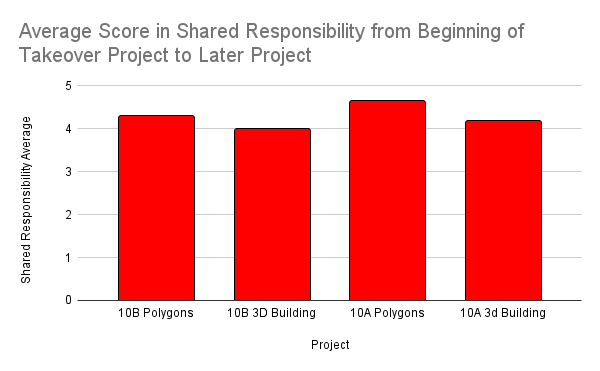
The average score for “shared responsibility” in each class comparing a project in October versus February.
The first polygon project from my first CUP was at a very early time in my teaching. I was still finding my sea legs in teaching and figuring out what worked and didn’t work. I was under an impression at the time that grading should be on the much lighter side since I wanted students to feel confident and as if they’re succeeding in my class. While I definitely want that to be the case, I learned from the first few units that I needed to push my students further. They weren’t properly being challenged and I wasn’t doing my part in ensuring that my students were becoming the best students they possibly could be. High expectations are a big part of my teaching, and by passing them along with freely handing out perfect categories, I’m sending the message that the student has already achieved their best, when in reality each and every student of mine is capable of achieving so much more.
My idea isn’t to be the world’s hardest grader or too strict on scoring. Quite the opposite. I want to be fair. I want my students to achieve what they can and realize that they’ve met my expectations, but they can push even harder to exceed them, and I want to reward that success with higher grades. Students are capable of so much, and I want them to feel motivated to prove it to me that they’re up for the challenge. While the grades were lower later on, they showed a growth within myself as a teacher willing to push my students harder to be better. Since this project, I’ve noticed students working much better on daily work assignments in groups. Students are asking each other more questions, explaining problems to each other, and working together in ways that is bolstering each other greatly in their understanding.
A big takeaway I had from the first project that I applied to the second was how I weighted my rubrics. I created a rubric in the first project that put way too much emphasis on the final finished project rather than who was doing what work. I had one student, who did absolutely nothing on the project, that scored higher than another student that worked hard on the project but didn’t put together a stellar finished product, simply because their group’s poster was fantastic. This was something I applied to the next project going forward, which was my blueprint project, making sure that I was rewarding the problem solving and collaboration as much as the work itself. That project, however, featured a very generalized rubric that didn’t fit specifics of the project at all, so while the scoring made more sense, the ultimate reasoning was rather arbitrary. By the time I got to the second project in this comparison, the 3D building project, I had curated a rubric that was both specific to the project as well as balanced in it’s collaboration, effort, and finished product grade. The grades for the last project felt much more accurate to what students deserved, and felt like an accurate representation of where students were at and where they could improve. My first unit of teaching certainly had many errors within it, but without those slip-ups, I wouldn’t have been able to learn from them and improve on them.
Real World Math
At the beginning of the year in my takeover, I struggled to apply real-world contexts to the math I taught. I always had a hard time of thinking creatively to find fun ways to connect it; I was struggling to figure out how teaching works as it was. As the year carried on, I put more effort into making real-world scenarios for problems. I noticed a massive shift in engagement from my students. They were getting super into the contexts and asking tons of questions related to them. The second I would tell them to solve a problem and find the answer once they had everything they needed, they would jump right to work excitedly. Math suddenly felt relevant to the students. I was finding with the lessons that I did standard lather-rinse-repeat practice that students were doing the problems but not understanding the problems. The Friday Flashback scores took hits and their ability to walk me through a problem was very limited. As I gave them more context-oriented problems, they were much more articulate in describing what was going on. Even when problems weren’t necessarily real-world applied but rather had hands-on learning, students were much more confident in their findings and explanations. Click here to watch some student compare the volumes of a pyramid and a cube using a water demonstration. The comparison of understanding between simple practice-based lessons versus the engaging real-world lessons is pretty wide in gap and will continue to be something I push in my classes going forwards. Let’s make math fun!
Friday Flashback Results
The Friday Flashback results for 10B and 10A don’t look the most promising off the bat, specifically 10B. As mentioned before, if students show up to class and do what they need to do, they’ll succeed on the Flashbacks. Around where the big drop-off in scores hit, there started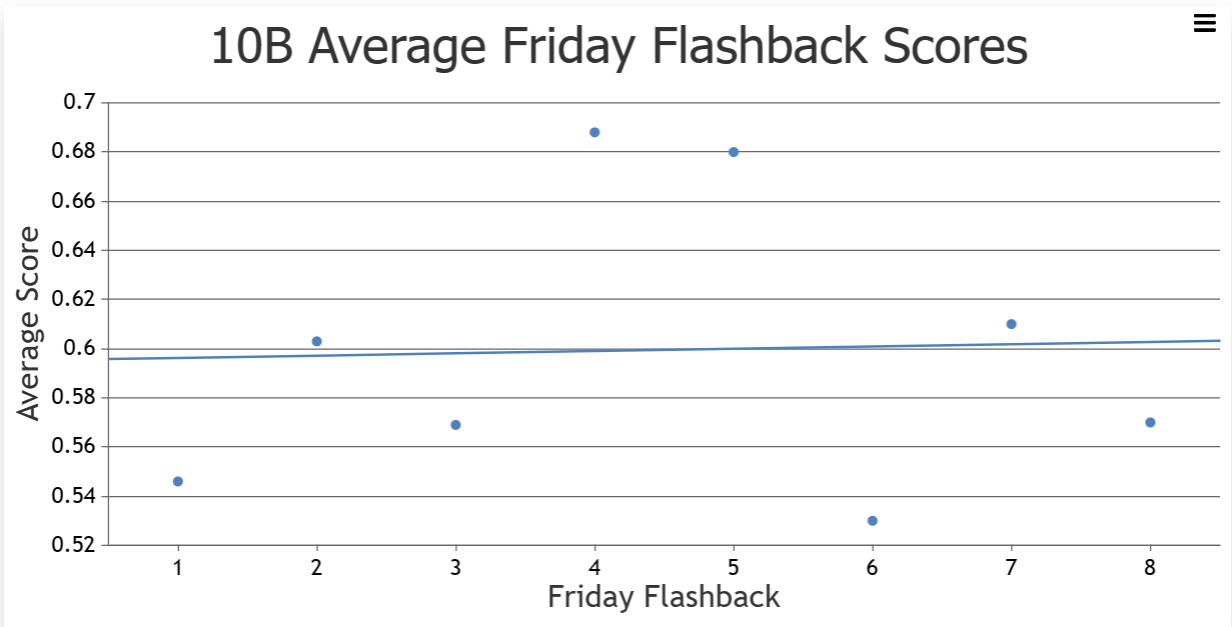 to be a massive amount of attendance issues in the first class, which led to lowered scores overall, while 10A saw a continued overall rise in average scores over that time. The score averages for both classes are fairly scattered, but the data does include a line of best fit (yay math!) to show how still, overtime there was generally growth in both classes. Learning isn’t always linear, something I had to remind myself throughout the year, as students will show peaks and valleys in their learning. In anything in life, learning isn’t going to be a steady upward increase, but the important measure is that over time, growth has still shown itself.
A big thing I think I could have adjusted for a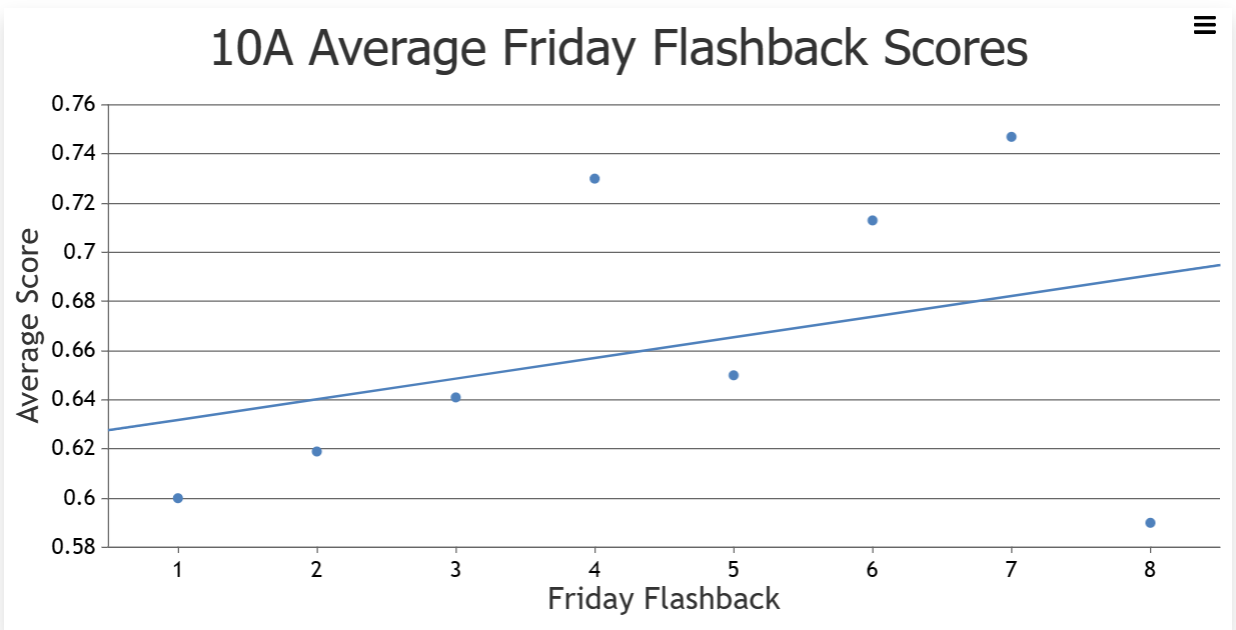 better read on learning is by using these Flashbacks more as a way to see what to focus more time on going forward. I felt a lot of pressure to keep the class moving since we have to get everything covered before MCAS, so I would usually only address things very quickly. However, I think it would have been worth it to spend a little more time addressing these favorite no’s and ensuring that students really felt comfortable with the content. While there was growth seen over time, it would have been nice to see the growth happen within each unit or topic covered.