1.A.1 Subject Matter Knowledge (explanation and evidence)
Subject matter knowledge was something that I built on greatly as the year went on. I started the year with the intent of valuing the different ways of thinking and having students doing the critical thinking. However, the impact was less-than desirable at the beginning of my takeover. I would answer any questions immediately without any room for students to think, explain everything to students at the board without giving them a chance to think about it themselves, and would try to pigeonhole students into one method of solving. As I got more comfortable teaching, I started putting the thinking back into the students hands, pushing them to think more critically. I had students asking deeper questions about the content in an effort to understand more about the material (view Teaching Philosophy video for evidence). Students have been pushed to explain their thinking more through their work to show their understanding of the content. Overall growth in understanding has been seen in Friday Flashback quiz results, and students are being pushed to work at a higher level with deeper-thinking assignments (view CUP 2, Growth Video, and High Expectations standards).
1A.4: Well-Structured Lessons (explanation and evidence)
At the start of the year, I hadn’t exactly put together the most impactful lessons. I hadn’t spaced out time well enough for students that needed more of a challenge or for students who needed more time with material. I also had fallen into the trap at times of just giving students simple practice worksheets and letting them work. As the year went on, I worked hard to try to make the lessons as engaging as possible while pushing their thinking. One style of lesson I used more often later on was the 3-Act Math-styled lessons, where students are set up with an engaging real-world problem that they must make a prediction with, need to think about the information they need and how to solve it, then solve the problem and see the answer. I started to utilize this during my second CUP and recognized the immediate increase in engagement students showed.
One of my best lessons this whole year was my track and field equity vs. equality lesson, where I showed students this video (from 2:17 to 3:17) and had them predict whether they thought lane 8 had an unfair advantage or not (click here to view my slideshow presentation from that lesson). The students were then asked to find how far each runner would have to run if they all started at the exact same spot. Students were heavily engaged in the context of the problem. There were multiple access points with a video, a chance to write thoughts and make a prediction, and a chance to do the math out. The students were provided a diagram of a track with all the information they would need to solve the problem but weren’t directly told what to do with that information, pushing this lesson into the level 3 questioning category. The students had the thinking put on them and were asked to apply their content knowledge to a real-world problem and problem solve with a type of problem they had not seen before, connecting to three of my major learning goals.
Click here to view my teaching philosophy video, which highlights some clips from this lesson. Click here to view the worksheet. Click here to view the diagram students were given.
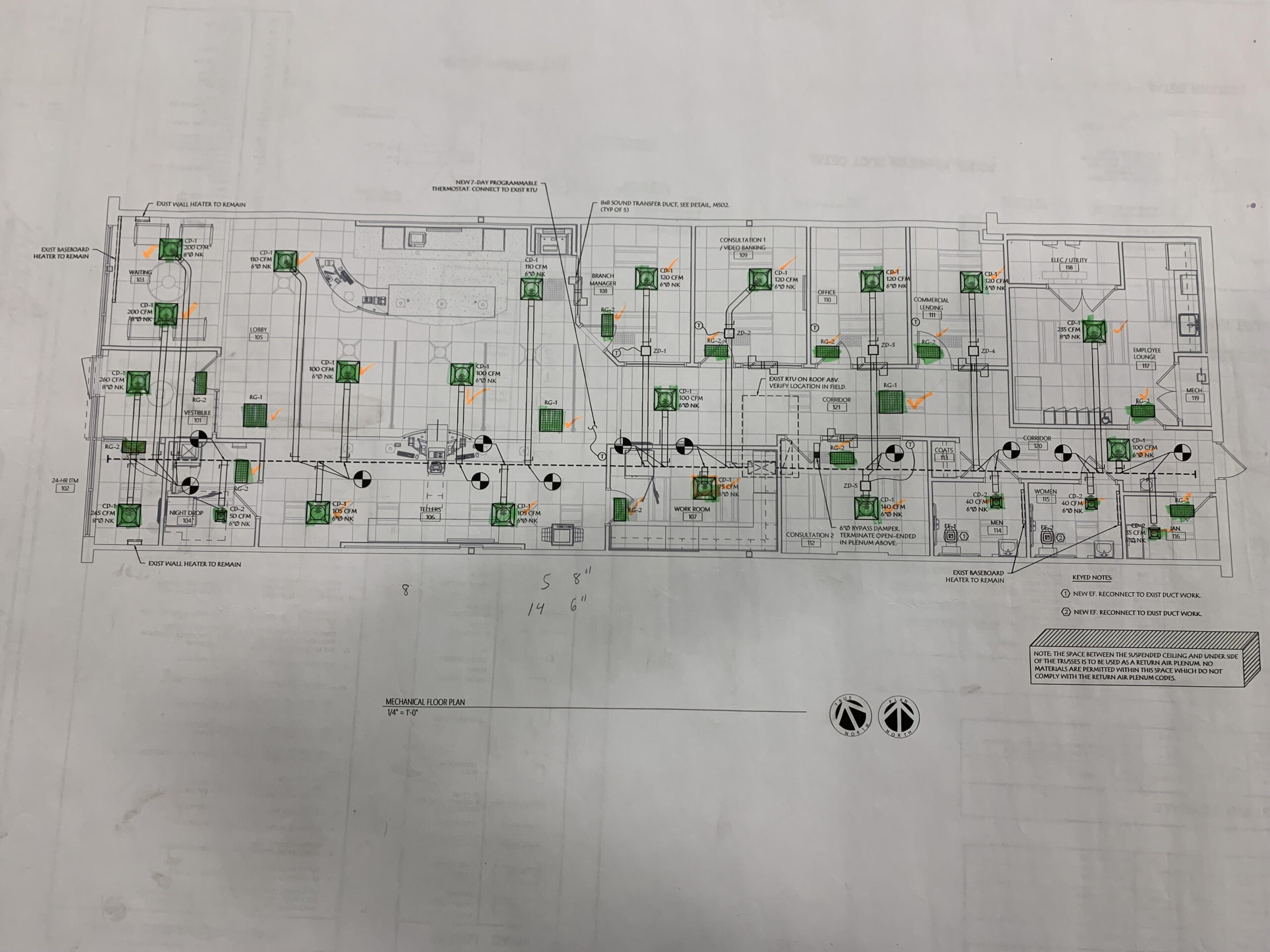
Blueprints to a building a student’s dad brought in for us to use in a lesson! This led to the creation of the Blueprint Project in the quadrilateral and coordinate proof unit.
I also worked to try to include my students into my lessons. One student had a dad that worked with building blueprints and brought some in for us to use in a lesson. This led to my quadrilateral and coordinate proof unit being centered around making blueprints! The students were really into looking at the blueprints and making their own, and it tied in the coordinate plane since the real blueprints utilized a coordinate plane, as well as quadrilateral proofs to make sure students knew exactly what shape the rooms were. Through this year, I’ve tried to incorporate student interests into my lessons. On the first day of school, my mentor teacher Kyle Pahigian assigned students a Google Form survey to get to know them better. The students were asked to put their interests on the form, which I then used as a basis for setting up different units or lessons, including one unit in transformations where we built it around playing Pac-Man and Tetris, tying to students’ love of video games.
1B.2: Adjustment to Practice (explanation and evidence)
Adjustment to practice is an important step in successful teaching. As a teacher, I need to be able to evaluate my students and make adjustments from there to make sure students are getting the best education possible and that all material is being covered in a way that is approachable to all students. From my second CUP during the Packing Project, I had students choose different real-world items to think about packaging in a rectangular prism box, which then asked them to think about the differences in volume to see how much space is available for packing peanuts and such. I knew at that point in my unit that students were at different places. Some needed more of a challenge, and others needed more support. I decided for this assignment to have students choose what challenge level they would like to work with. Some students were able to choose harder questions that pushed them more, while others could choose less complex shapes to help make the math more approachable. Each item still had extra extension questions so that each student could push even further if they felt up for it and could still earn extra credit while staying at a level good for them. For students that really needed extra support like IEP students, I had extra scaffolded versions with diagrams drawn, helpful hints provided, and sentence starters, which I wrote out in pen for them and had extra copies available if any other students felt like they needed more support as well.
I also have utilized the Friday Flashback as an assessment tool for determining what should be reviewed in class the following week to help fix some mistakes. While I recognize that I should have provided more attention to readdressing mistakes, I was still able to use it as a way to make some adjustments to my teaching to better fir the students’ learning. When I’ve done MCAS practice in class, I will offer up an answer key at the front of the room to allow students the chance to check their work as they go without giving away how to do the problems so the thinking is still on them. This gives them more instantaneous feedback while pushing them to work collaboratively and problem-solve with perseverance when they make mistakes, connecting to some key learning goals.
During the lesson from my second round for my numeracy class, I provided students feedback on their papers after each day of work and then addressed any common mistakes I saw from everyone’s papers the next class (see an example of this assignment at the bottom of this link). This helped to redirect students to where they needed to go and helped provide them an understanding of where they were at with the content. If something was written on the vast majority of papers, I would pull the class together and go over it on the board by utilizing an example and projecting it onto the board with the ELMO. This way, I knew I covered everything students were confused on and had given students ample opportunity to adjust their mistakes and get as much out of the content as possible.