*Note* Much of my evidence and data is connected to my 10th grade students, as I had started my take over in the 10th grade as early as quarter 1, while the 8th grade takeover only started in quarter 3.
1. Students will Develop Strong Problem-Solving and Perseverance Skills as Mathematicians
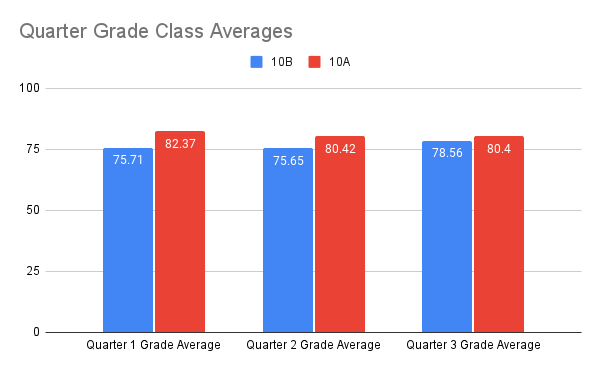
Quarter-by-quarter class averages for both 10B and 10A.
Problem-solving perseverance is the most common measure utilized in assignments in my class. Every assignment throughout the year has had a grade category of problem solving and perseverance. For the evidence here, I felt it best to show the general average grades of the classes quarter by quarter for my 10th graders. The evidence here shows fairly consistent grade averages from the students all around. Quarter 1 in 10A shows a roughly 2% higher grade average compared to quarter 2 and 3. This is likely related to the light grading of my first unit (see number 2. below) and to most of the quarter being run by my mentor teacher Kyle Pahigian, who has had plenty of experience to know how to get the most out of her students. The second and third quarter show very consistent grades for 10A and a large increase in 10B. While the data may look consistent for 10A with quarter 2 and 3, more than half the students in the class showed improvement over the quarter. 12 students in 10A improved upon their quarter 2 grade, and between 10B and 10A, at least 3 students have seen a grade improvement beyond 10%. Click here to read my reflections on the grades, what the cause of the lack of improvement could be, and my thoughts on pushing forwards.
2. Students will Build Strong Collaboration Skills in their Work with Their Classmates
Collaboration is a big part of my classroom each and every day. Students sit in groups and are expected to be good team members for their peers, something we made sure to stress on the second day. One way I measured the progress of this was by looking at scores in group projects for the “shared responsibility” tab in the rubrics and comparing them from a project in the beginning of my takeover to a project more recently completed. The data here tells a different story than what actually took place, which provided me a great place of reflection going forward in my teaching. (Click here to read my reflections about the data)
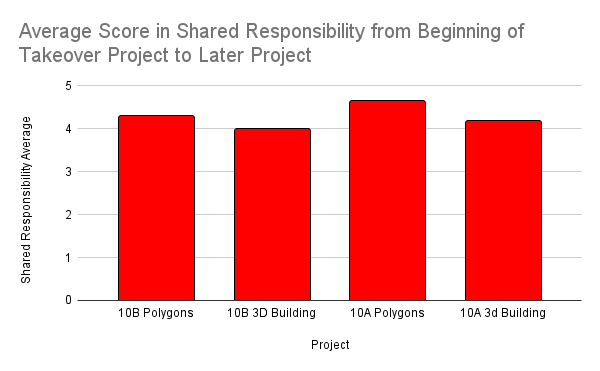
The average score for “shared responsibility” in each class comparing a project in October versus February.
The scores in both classes dipped lower than before by a sizeable margin. My grading increased in toughness throughout the year, which leads to the difference in where students were at in October versus now. At first, I graded this category significantly loosely, providing most students an “exceeding expectations” mark. In the more recent project from February, I had picked up my expectations on what I was looking for from my students to push them to be greater group members and adhere to the list we came up with at the beginning of the year. The second project results show a decrease in student collaboration, but from what I had noticed between the two classes, the collaboration was on part with the previous project, if not significantly stronger. My reflection will dive deeper into this data and how it impacted the rest of the year and the growth in this category.
3. Students will Be Able to Apply Their Knowledge of Math to Real-World Problems
The evidence related to this section is mostly based on the quality of the work itself. The samples provided are available for viewing at this link here. The work shows students’ ability to dissect a real-world situation and determine what mathematical concepts come into play with them. Students are able to show their understanding through low-stakes writing in determining what they need to solve the problem. A lot of the real-world context problems worked more in my class as ways to get comfortable with the concepts themselves, as if students can understand how they apply in a context that makes sense to them, the application and computation should feel more sensical and fluid from there. My aim is to make the more abstract math understandable for all students, and the easiest way to relate something abstract like math is to show how it’s directly connected to real life.
In looking at the Mr. Clean and Air Mattress problems from my second CUP, students took what they learned from the 3D building project and applied it to situations that are seen in daily lives. In the first assignment, students were expected to determine how much of a bottle of Mr. Clean was holding liquid compared to how much the bottle should hold. No student came to the correct conclusion, but each student was showing connections between the math and the scenario. Meanwhile, the second assignment had students predicting how long it would take an air mattress to fill up. A significant amount of students got the correct answer in their prediction, showing that over time students can apply what they know about math to a real-world scenario.
Click here to view my Teaching Philosophy video, which highlights a lot of real-world problems in action, and click here to read more about my Teaching Philosophy.
4. Students will Show Growth in Their Grasping of Content and Conceptual Understanding
A big way we measured conceptual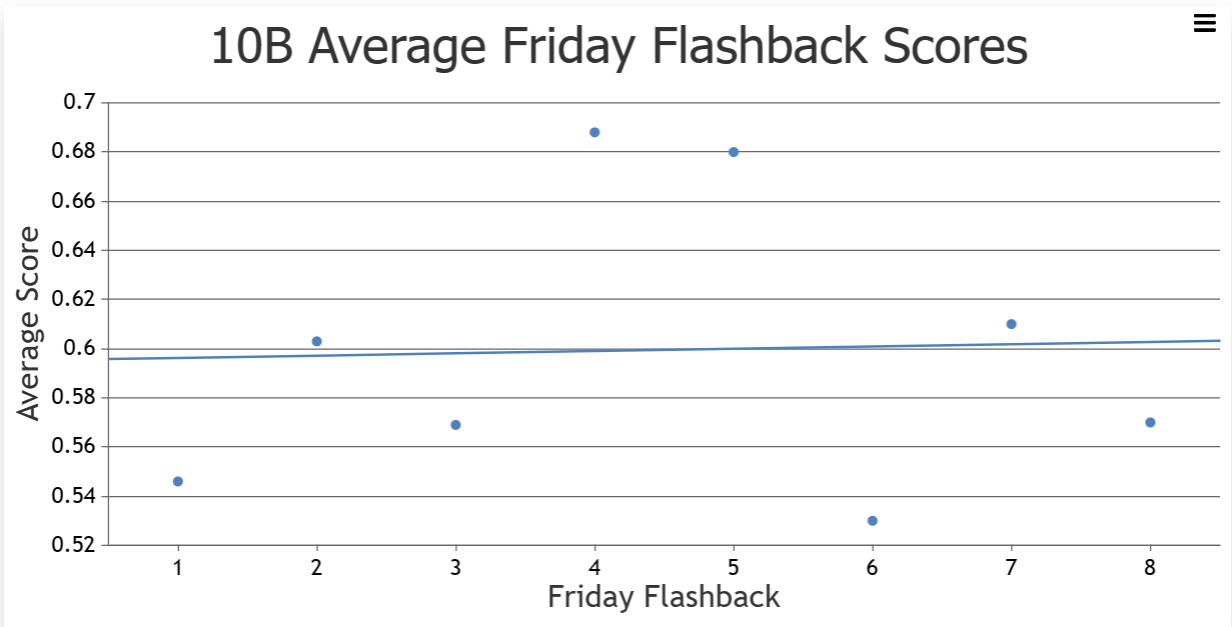 understanding this year in 10th grade was through utilizing a Friday Flashback to assess where students were at following the week of learning. The Friday Flashback is a fairly low-pressure assessment that works like a quiz with the aim of getting a measure of how well students understood the material and what common mistakes we saw that may have needed to be addressed. The Friday Flashbacks were never perfect, as students were being freshly quizzed without much time out of school to prepare, but it at least showed us what students took away from the week in the class. In general, if a student came in and did what they had to in class, they would succeed. The data here shows the average scores of the
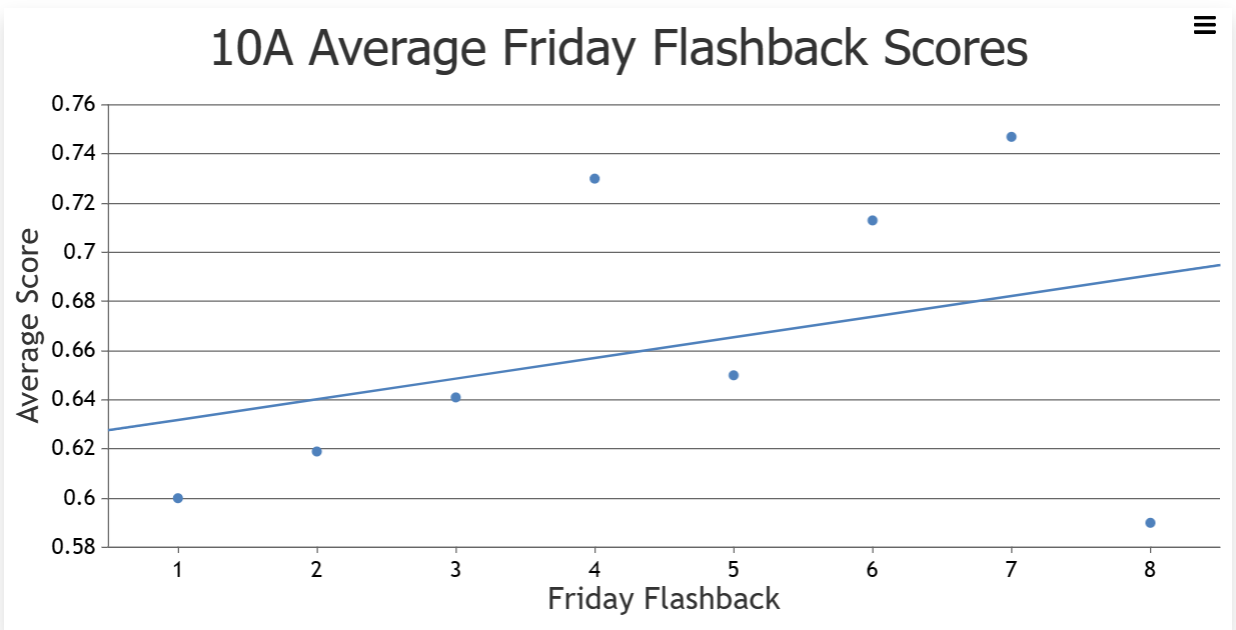 Friday Flashbacks for both 10B (my first period class) and 10A (my second period class) across my time during my geometry takeover. For more on my reflections about the data and Friday Flashbacks, click here.