Author Archives: bcapogrosso

Multicomponent lattice bosons

Relevant publications on the topic: 

Multiworm algorithm quantum Monte Carlo or on arXiv

Thermometry of bosonic mixtures in Optical Lattices via Demixing or on arXiv

Inter-species entanglement of Bose-Bose mixtures trapped in optical lattices or on arXiv

Quasi-molecular bosonic complexes-a pathway to SQUID with controlled sensitivity or on arXiv

Demixing effects in mixtures of two bosonic species or on arXiv

Analysis and resolution of the ground-state degeneracy of the two-component Bose-Hubbard model or on arXiv

Ising antiferromagnet with ultracold bosonic mixtures confined in a harmonic trap or on arXiv

Mott-insulator-SF transition lobe in the presence of a second superfluid component 

Critical entropies for magnetic ordering in bosonic mixtures on a lattice or on arXiv

Mott-insulator-to-superfluid transition in Bose-Bose mixtures in a two-dimensional lattice or on arXiv

Sign-alternating interaction mediated by strongly correlated lattice bosons or on arXiv


Braiding properties of worldline configurations (in progress)

Within the path-integral approach of quantum mechanics, transition probability amplitudes
can be computed in terms of superpositions of classical paths. In this formulation, all possible routes are taken into account but only those which superpose constructively will contribute the most to the quantum physical process.
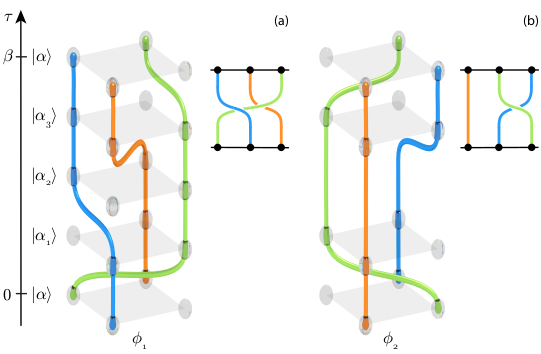
Therefore, there exists a parallel between a certain quantum process and a set of classical possibilities which result in the same outcome. We use this analogy and consider quantum strongly-correlated many-body ground-states as described in terms of constructive superposition of collections of classical paths, i.e. worldline configurations (see picture below for an example of worldliness configurations of three particles on a 2X2 lattice).

Configurations emerge within the framework of Feynman’s path-integral formulation of the density matrix of a many-body system, in the limit of zero temperature. Within this framework, each quantum particle is mapped onto a trajectory (also known as worldline) in space and imaginary-time, so that the quantum system is now described in terms of collections of worldlines in space and imaginary-time, i.e. worldline configurations. As a result, there exists a correspondence between the D-dimensional quantum system and a (D+1)-dimensional classical system. Each worldline configuration is the analog of a single-particle space-time path in the path-integral formulation of quantum mechanics. The kinetic-energy term in the Hamiltonian drives worldlines to intertwine with each others. For hard-core bosons, these intertwined set of worldlines can be interpreted as braids and therefore can be assigned a topological structure, i.e. a way to classify braiding events among worldlines. Configurations can be considered as a visualization of the interplay between the kinetic and interaction terms of the Hamiltonian. The interplay between these two terms is ultimately responsible for ground-state properties. Therefore, one can expect that braiding properties of configurations should reflect ground-state properties. In the figure above, smaller figures are depictions of geometric braids associated to the worldlines configurations. In these depictions, only occupied sites are included and cut worldlines are the ones behind another worldline. Our preliminary results show that braiding properties of relevant configurations can reflect known features of the ground-state considered.

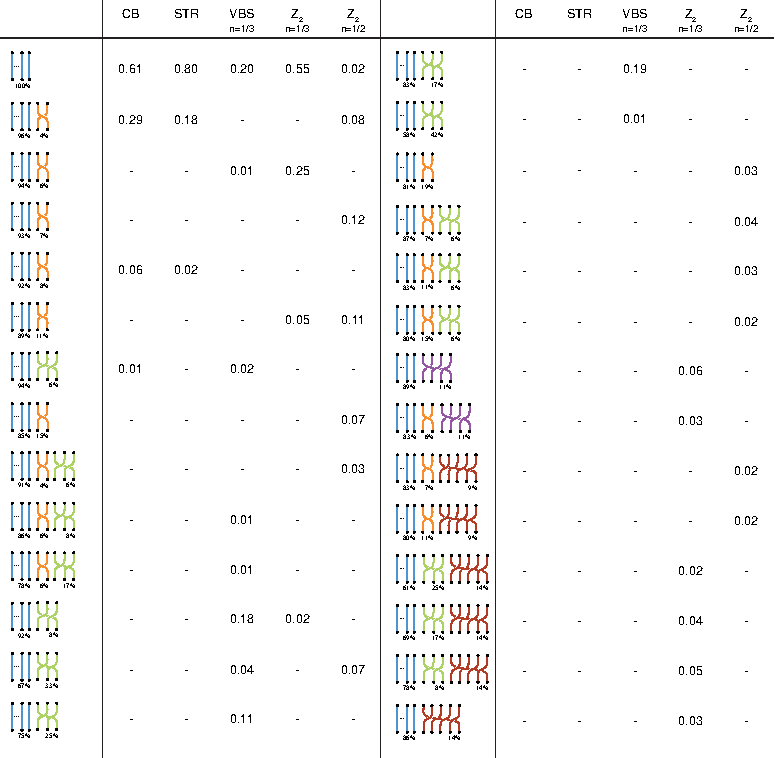
To partially characterize braids, we study the statistics of permutation cycles. Permutation cycles are obtained by gluing together worldlines at imaginary time 0 and beta. In the table below, we sketch the most probable (with a probability greater than 0.01) arrangement of permutation cycles (first column) for a variety of insulating phases, with corresponding probability to appear in the expansion of the partition function (remaining columns).
Each arrangement of permutation cycles is represented in terms of the fraction of worldlines (percentages under the braid diagrams) participating to the corresponding permutation cycle. We notice that for checkerboard (CB) and stripe (STR) phases more than 60% of the configurations are trivial braids while most of the remaining ones only possess one or few permutation cycles involving two worldlines. In the valence-bond (VBS) case, 57% of configurations possess permutation cycles involving three particles consistent with local resonances harbored in isolated hexagons occupied by three particles. Finally, permutation cycles involving four and five particles only appears in the Z2 phase with, in some cases, 30-40% of particles involved in permutation cycles with more than one particle. The observation that longer permutation cycles only appear in the Z2 phase and a considerable number of particles are involved in them is consistent with the presence of more complicated braids which extend throughout the lattice. Overall, all these observations support our expectation that the relevant topological structures would reflect certain ground-state properties. 

To learn more, see:

Sci Rep

Other relevant publications:

Permutation cycles of hardcore Bose-Hubbard models on square and kagome lattices or on arXiv

Dipolar Bosons

Supersolid phases with lattice dipolar bosons
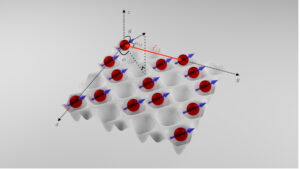
Supersolidity is a fascinating state of matter in which crystalline order and global phase coherence are simultaneously present. Ultracold quantum gases offer a highly controllable platform where experimental efforts for the realization of this state of matter have focused. For example, dipolar interactions have been shown to be responsible for a spontaneous formation of droplets of gas organized in a crystalline structure.

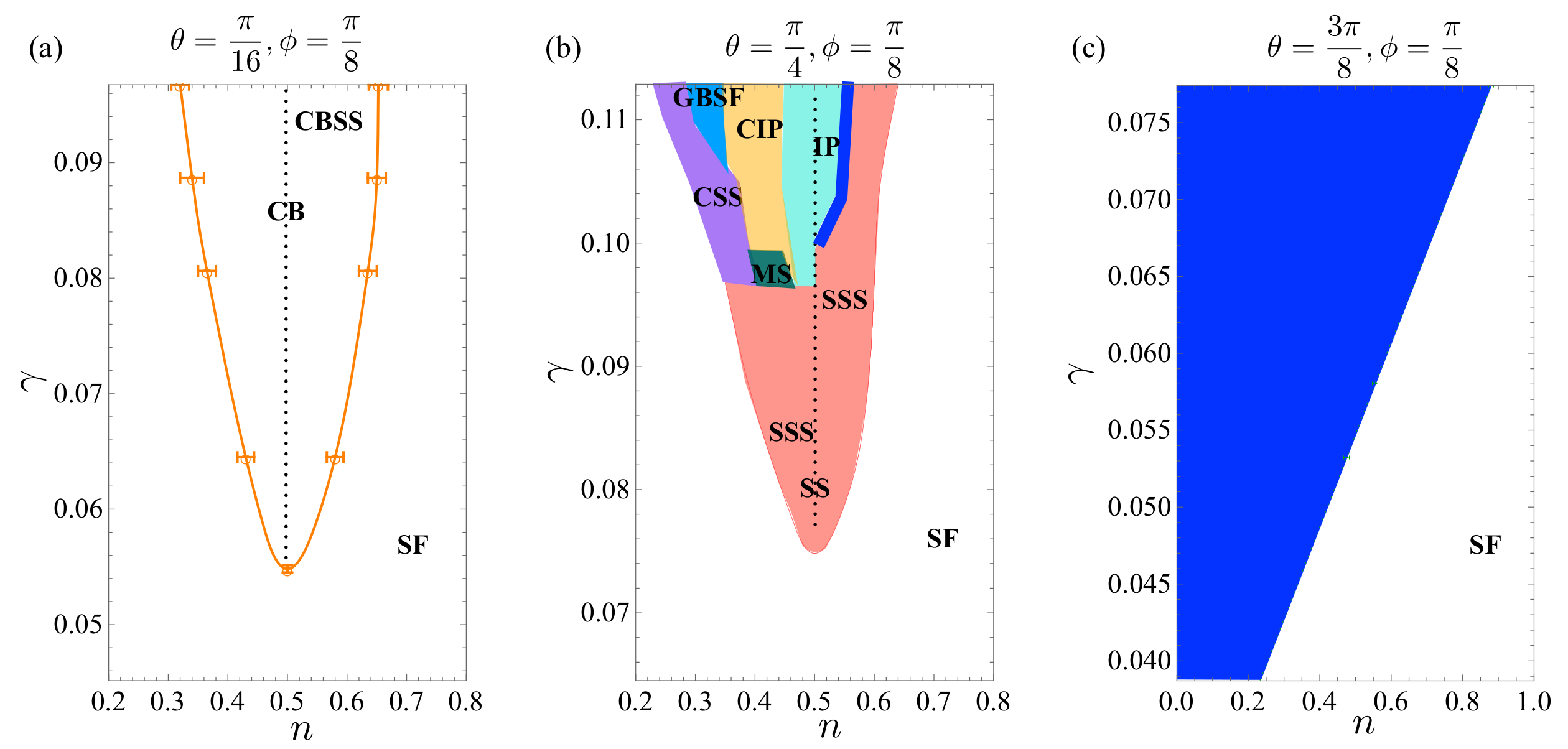
We have studied under which experimental conditions dipolar  bosons trapped in a square optical lattice can stabilize a variety of supersolid phases. In the systems studied, dipoles are parallel to each other. Depending on the direction of the dipoles, various types of supersolids (e.g. checkerboard, stripe) and solids (checkerboard, stripe, diagonal stripe, and an incompressible phase) can be stabilized. We have found a cluster supersolid characterized by the formation of horizontal clusters of particles. These clusters order along a direction at an angle with the horizontal. Moreover, we have found what we call a grain-boundary superfluid. In this phase, regions with solid order are separated by extended defects — grain boundaries — which support superfluidity.  Below, we show the phase diagrams  for three different choices of the polarization angle.

In the picture above, the x-axis is the filling factor n and the y-axis is the dipolar interaction strength $\gamma$. For polar angles $\theta\lesssim \frac{\pi}{6}$, the solid phase stabilized at half filling is a checkerboard solid (CB) and the supersolid phase is a checkerboard supersolid (CBSS); for $\theta\gtrsim \frac{\pi}{6}$, the half filling solid phase is a stripe solid (SS) and the supersolid phase around half filling is a stripe supersolid SSS. In (b), CSS stands for cluster supersolid, IP stands for the incompressible ground states stabilized at rational filling factors, CIP is a cluster incompressible phase (see text for more details), GBSF is a grain-boundary superfluid, and MS is a metastable region. Dark blue regions in (b) and (c) correspond to first-order phase transitions. Dotted lines at filling factor $n=0.5$ represent solid phases CB or SS.

In the picture below we show the particle distribution in the lattice for some of the phases found. Here, each circle corresponds to a single lattice site, and its radius is proportional to the local density.
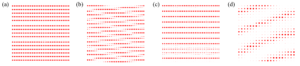
(a) is an example of incompressible phase where the space between filled rows can be irregular; (b) is an example of the cluster solid; (c) is an example of the grain-boundary superfluid; (d) shows phase coexistence of vacuum and superfluid regions across a first order phase transition. 

To learn more, see:

PRA or https://arxiv.org/pdf/2301.00099.pdf

PRA or https://arxiv.org/pdf/2201.03756.pdf

PRA or https://arxiv.org/pdf/2010.13673.pdf

Other relevant publications:

Equilibrium phases of tilted dipolar lattice bosons or on arXiv

Quantum phases of dipolar soft-core bosons or on arXiv

Quantum phases of dipolar bosons in bilayer geometry or on arXiv

Solid phases and pairing in a mixture of polar molecules and atoms or on arXiv

Quantum Phases of Cold Polar Molecules in 2D Optical Lattices or on arXiv