Thursday, June 12, 2025
Blogger, Kacie Lennon
Daily Highlights
- Ferry to Geyikli
- Shuttle to the archaeological site of Troy
- Visit to the Troy Museum and the archaeological mound
- Lunch near the site
- Arrival in Iznik
We began our day by leaving Bozcaada. It was sad to leave the island and the beach life we had been enjoying over the past couple of days, but we left our hotel at 8:30 a.m. to catch the 9:00 a.m. ferry to Geyikli and assemble in our vans to travel to the site of Troy. The drive to the museum and archaeological site provided an excellent opportunity to survey the landscape of western Anatolia. It’s a landscape that feels subtly monumental: expansive golden and green plains extending beneath broad skies, interrupted only by the rare village or farm. As we drove along, it was amazing to contemplate that beneath this dust and wheat rests the memory of Homer’s Troy, a city steeped in war, wealth, and poetry.
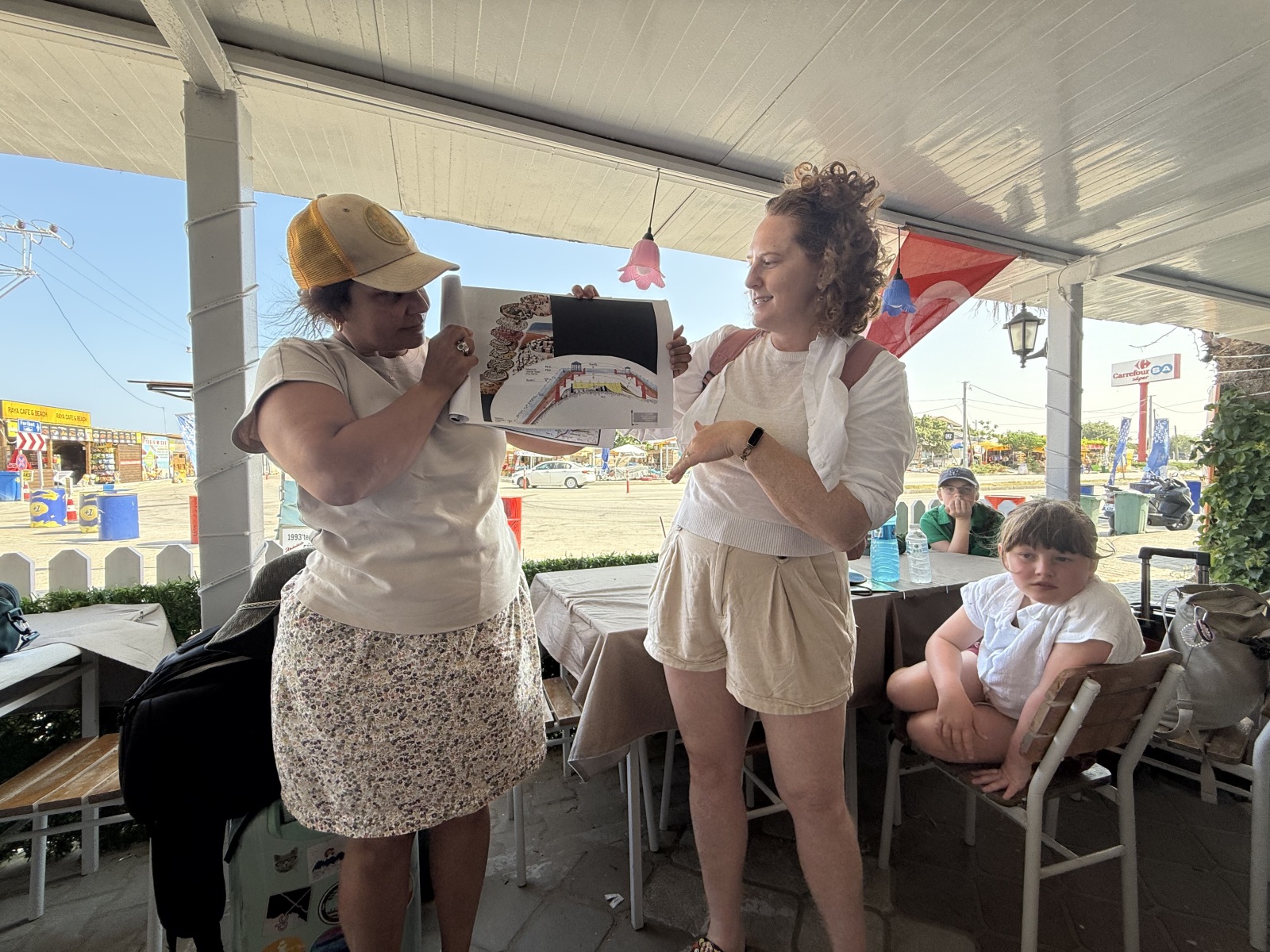
Dr. Human and Dr. Pitamber Lecturing on Troy
The Troy Museum
Before walking the ruins of ancient Troy, we stopped at the Troy Museum—an architectural marvel in its own right and a museum that, fittingly, feels like a journey through time. We were incredibly fortunate to be guided through the day by Dr. Human, a friend of Dr. Pitamber and a specialist in the archaeology of Troy. Not only has she worked extensively on the site itself, but she has also collaborated directly with the architects who designed the museum, having been part of the team that helped bring the vision to life.
The Troy museum is ingeniously designed to mirror the archaeological process. As you enter the building, you descend downward through time, walking through the layers of Troy beneath the surface. The museum’s bottom floor orients you in the broader Anatolian context, helping you understand Troy not as a single legend, but as a node in thousands of years of human settlement, trade, and war. You then ascend ramps that take you to the first and second floors through the layers of Troy, beginning with Troy I and ending with Troy IX.
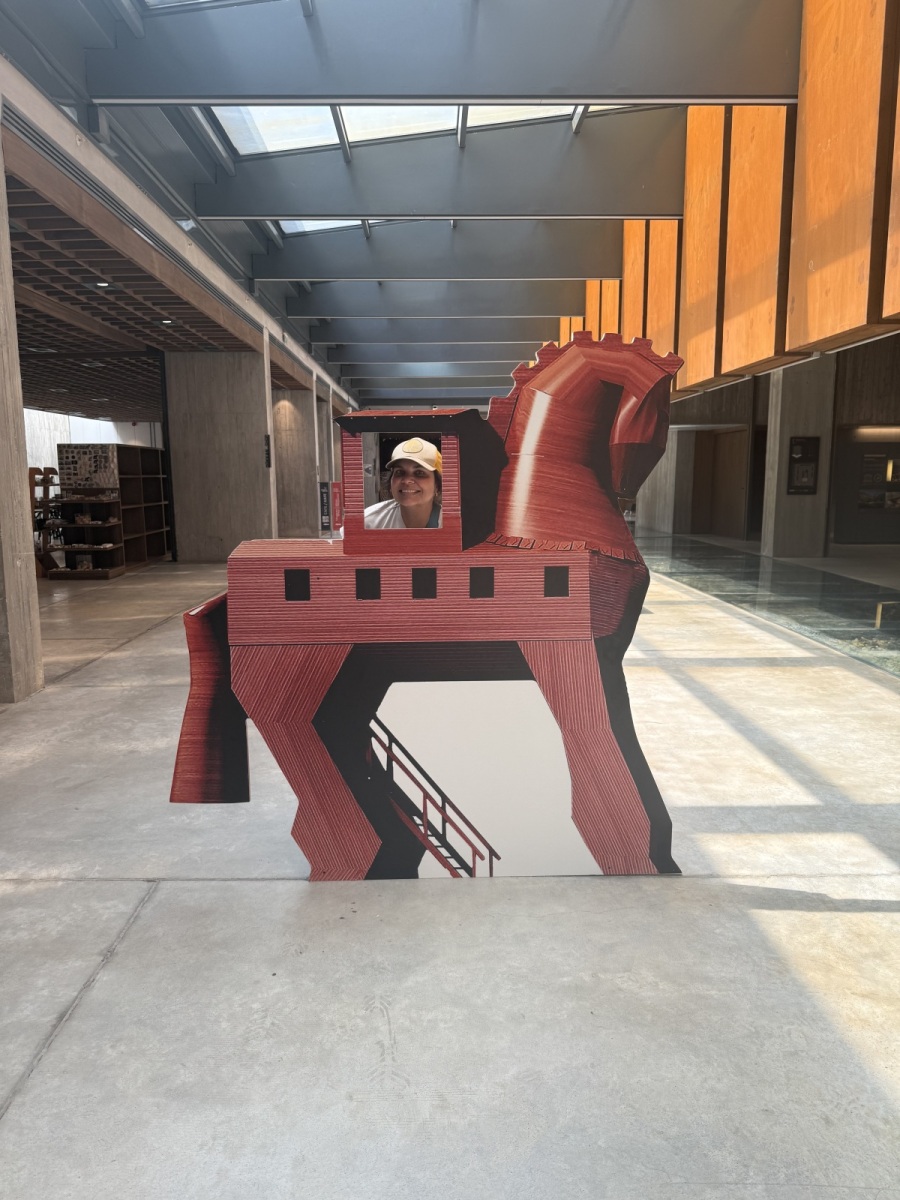
Dr. Pitamber inside the Trojan Horse
Troy I–III (3000–2200 BCE) is represented through finds from the early maritime settlement— longhouses, megarons, and fortified citadel walls suggest a small yet prosperous community engaged in long-distance trade. Displays emphasize the rapid development and ultimate destruction of these earliest cities by fire. Troy IV–V reflects a downturn, a period of isolation and relative poverty marked by simpler architecture and signs of internal instability, such as the use of dome ovens, which caused domestic fires.
Troy VI–VII (1700–1000 BCE), often associated with the height of “Trojan high culture,” reveals a populous, cosmopolitan city with large megaron-style palaces, defensive walls built to resist chariot attacks, and evidence of complex dye production from seashells. The architectural shift in Troy VII, with its thicker walls and hidden food storage beneath floors, indicates fear and instability—possibly the aftermath of a siege or war. These changes are presented alongside theories about whether this phase reflects the historical reality behind the Trojan War myth.
By the time you reach Troy VIII and IX, you encounter the city’s transformation into a sacred and political site under the Greeks and then the Romans. Visitors learn how Hellenistic settlers established new temples and agoras atop the ruins, seeing Troy as a pilgrimage site commemorating the legendary past. Roman Troy (Ilion) expanded with stoas, theaters, and imperial dedications, including inscriptions from Augustus linking his lineage to Aeneas.
Artifacts—clay figurines, spindle whorls, Mycenaean-style pottery, arrowheads, seal impressions, and fragments of frescoes—bring each layer to life, offering intimate glimpses into daily rituals, trade networks, and shifting cultural influences. These objects are flanked by interactive displays that animate Troy’s complex chronology, guiding visitors through cycles of destruction and rebuilding, myth and materiality. The integration of digital reconstructions, stratigraphic diagrams, and tactile models invites you to think like an archaeologist, piecing together a city’s story from the debris of time.
The museum’s third floor brings this narrative full circle, chronicling the history of Troy’s excavation—both its triumphs and controversies. The section begins with Heinrich Schliemann, the infamous 19th-century treasure hunter who destroyed parts of Troy II in his rush to reach what he believed was Homeric Troy. Exhibits explore how his sensationalist claims and smuggling of “Priam’s Treasure” shaped modern perceptions of Troy.
Stele Outside of Troy I Walls
Archeological Troy
As we entered the archaeological site of Troy, we were greeted by a large reconstruction of the Trojan Horse. While clearly theatrical, it was a playful nod to the mythic legacy that continues to draw visitors from around the world. The shifting shoreline has left Troy perched on a hill, but in its earliest days, this site would have been nearly at the water’s edge, commanding the sea traffic between the Aegean and the Black Sea.
Our first stop was the Temple of Athena, once a grand sanctuary crowning the city during the Hellenistic and Roman phases of Troy, known in these eras as Ilion. Though only fragments of its coffered ceiling remain on site today, the temple would have stood as a visual anchor, signaling Troy’s renewed importance under Greek and Roman rule. This monument belonged to Troy VIII–IX, when Augustus and other Roman elites proudly claimed Trojan ancestry and invested in beautifying the site as a symbolic birthplace of the empire.
We then arrived at the Citadel Wall of Troy II/III. The modern restoration uses handmade and fired mudbricks to shield the fragile remains of the ancient clay bricks underneath, which have been preserved up to a height of nearly four meters. A protective canopy, built in 2003, shelters both the wall and the megaron just opposite, allowing visitors to observe these structures without further risking their deterioration.
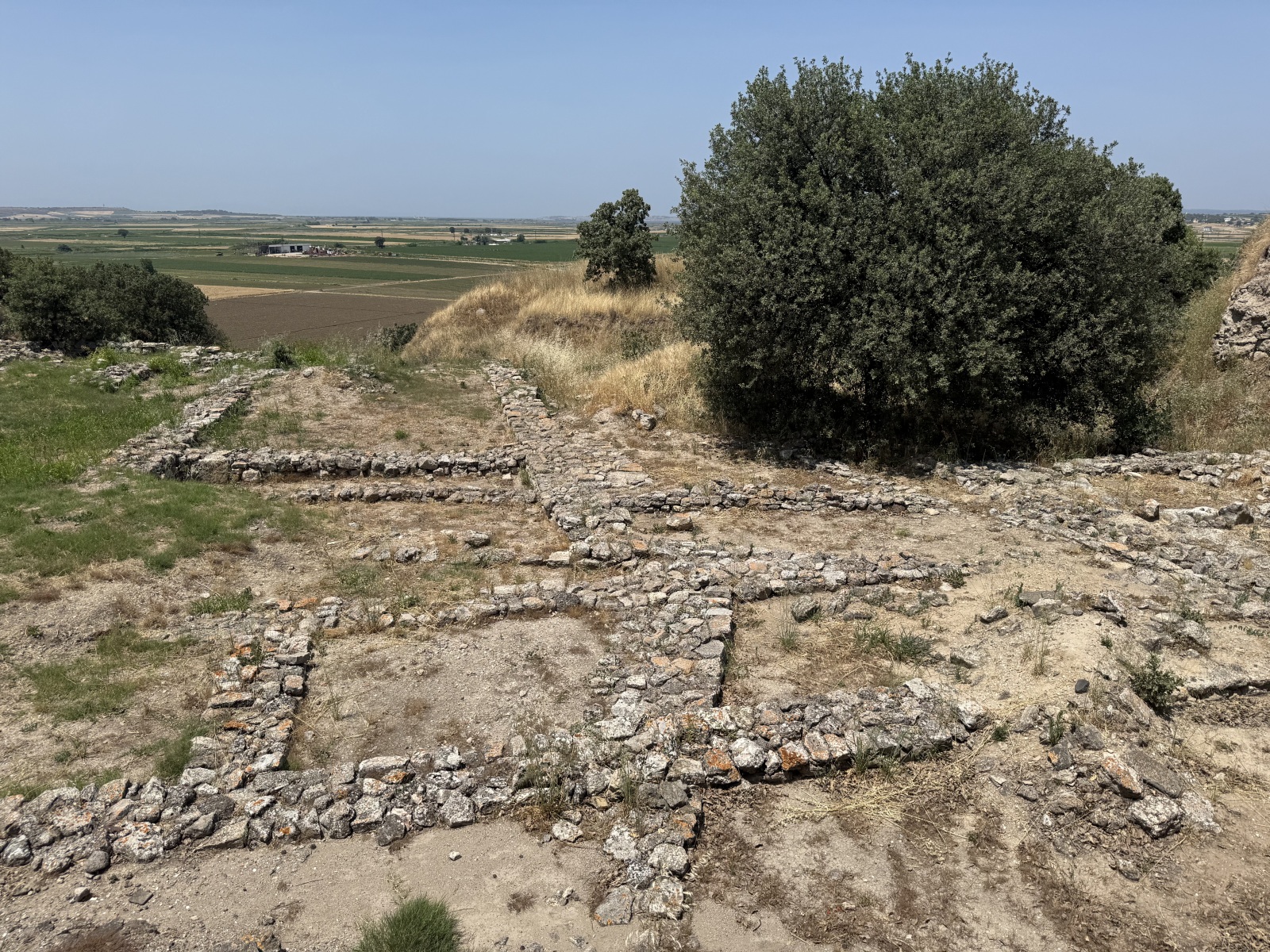
This megaron, a long, narrow rectangular building with a vestibule and central hearth, exemplifies elite domestic or possibly administrative architecture from the Early Bronze Age. Excavated between 1998 and 1999, it reveals construction techniques typical of Troy II/III, including mudbrick walls set on stone foundations, with traces of plastered interior surfaces and remnants of daily activities, such as carbonized grain and impressions of woven mats.
Adjacent to this are the foundations of another megaron, also associated with Troy II, likely part of the inner citadel complex. During this phase, the citadel would have been encircled by fortification walls stretching approximately 300 meters in length, built with stone bases and mudbrick superstructures, and elevated above the lower town to assert both defensive strength and political authority.
Continuing through the site, we reached the fortification wall of Troy I (ca. 2920 BCE), where a projecting tower flanks the gateway—an early example of complex defensive architecture in Anatolia. Just in front of the gateway once stood a stele, carved with the image of a human figure grasping a weapon—an emblem of power, perhaps divine or royal. Today, that stele resides in the Troy Museum, linking the site to its carefully preserved artifacts down the road.
We then came to the dramatic Schliemann Trench, a deep and jarring cut across the mound made by Heinrich Schliemann in the 1870s. Obsessed with finding Homeric Troy, Schliemann dug aggressively through the upper layers, destroying Roman and Hellenistic remains in his haste to reach Bronze Age levels. Today, the trench exposes a cross-section of Troy’s geology—a literal wound in the earth that has become a teaching tool. Standing at the edge, we could clearly see layers of walls, ash, and rebuilding that form the backbone of Troy’s historical narrative.
After climbing back up toward the Roman layers, we paused at the Odeion, a small Roman theater used for musical performances and civic meetings during Troy IX. Its semicircular shape and surviving marble seating hint at a time when the city, though diminished in power, was still culturally active under Roman administration.
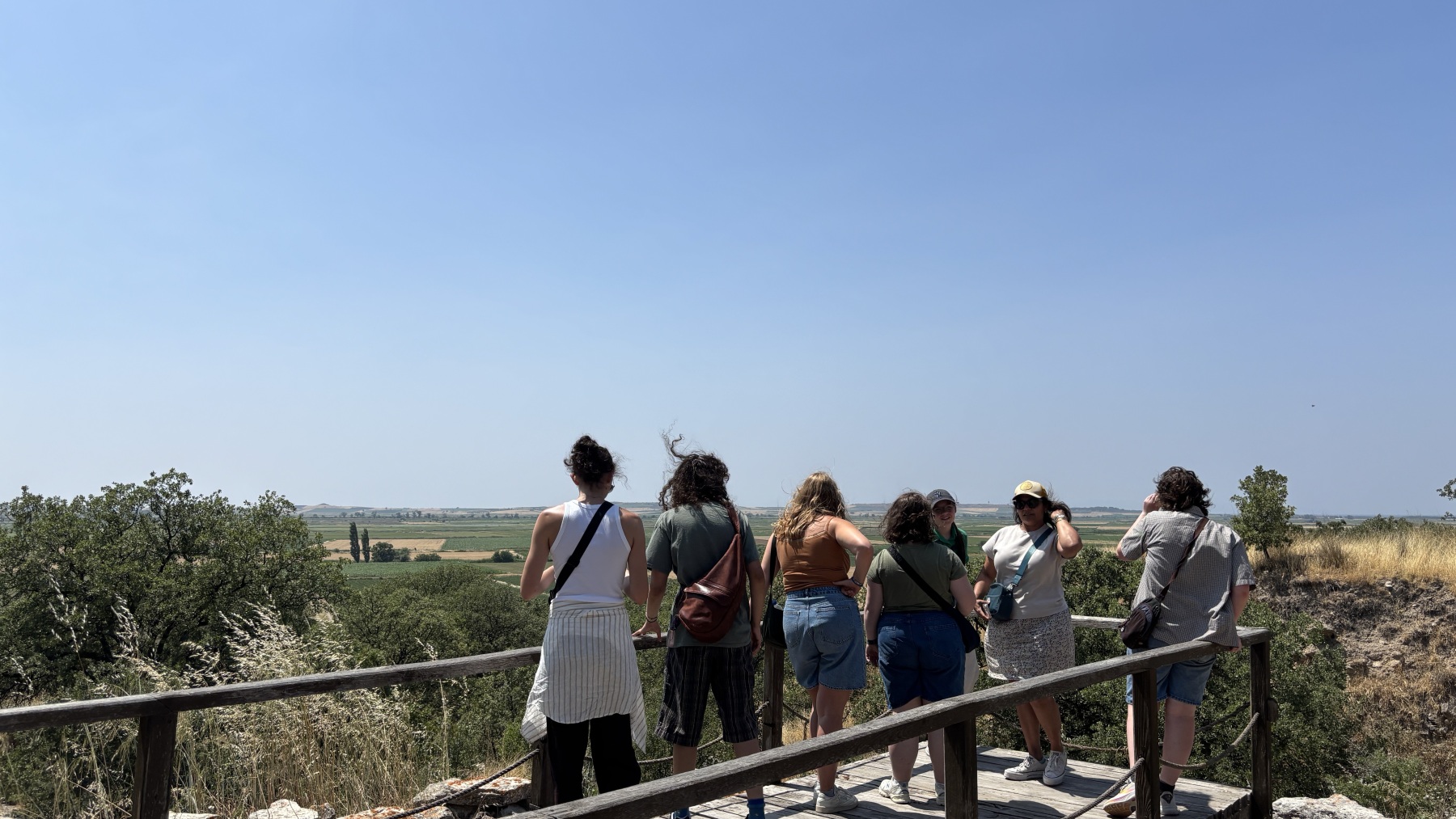
Overlooking silted plains from Troy
Excavations on the Site
After Heinrich Schliemann’s famously destructive dig in the 1870s, the site was systematically re-examined by a series of influential archaeologists who helped clarify Troy’s complex stratigraphy. Wilhelm Dörpfeld, Schliemann’s architectural advisor and later the site director, was the first to organize Troy’s remains into a coherent sequence of nine major layers, introducing the idea of Troy I–IX.
In the 1930s, American archaeologist Carl Blegen led excavations that refined this chronology and shifted focus from treasure to domestic life, uncovering crucial elements of Troy VI and VII and recognizing Troy VII as a possible candidate for Homeric Troy. His careful stratigraphic work established the groundwork for modern interpretations of the site. Most recently, from the 1980s into the early 2000s, Manfred Korfmann directed renewed excavations under the direction of the University of Tübingen. Korfmann’s team used advanced technologies such as remote sensing and geomagnetic surveys to reveal that Troy was much larger than previously thought, including a substantial lower town extending toward the plain. His efforts reignited debate over Troy’s historical credibility as a prominent Late Bronze Age city involved in regional conflict—if not exactly the war of gods and heroes Homer envisioned, then certainly a city of real geopolitical significance.
On the Road Again
After a long day of exploring Troy, we got back in the vans to complete the final leg of our trip to İznik. After stopping for a quick lunch of delicious köfte—savory Turkish meatballs served with fresh bread—we continued our drive through the golden countryside of northwestern Turkey. After settling into our hotel, many of us took a walk along the lake or gathered for dinner, already buzzing about the historical and architectural sites awaiting us in the next chapter of our journey.
Dr. Pitamber inside the Trojan Horse
Reflections
Today’s visit was a powerful reminder that archaeology is not just about digging things up—it’s about what stories we choose to tell once we do. Troy may never resolve all of its mysteries: Was there truly a war? Who were the people who lived and died here? But the site remains incredibly rich—not just in material terms, but in its capacity to invite imagination, interpretation, and debate.
Some lingering questions I was left with today are:
- How do we balance scholarly integrity with public storytelling at mythic sites like Troy?
- What is the responsibility of a museum to tell contested or incomplete histories?