Monday, June 16, 2025
Blogger, Jemma Salisbury
The Final Day of the Trip
Today’s Itinerary Featured:
- Everyone setting off for their next destination!
The Istanbul Airport Group
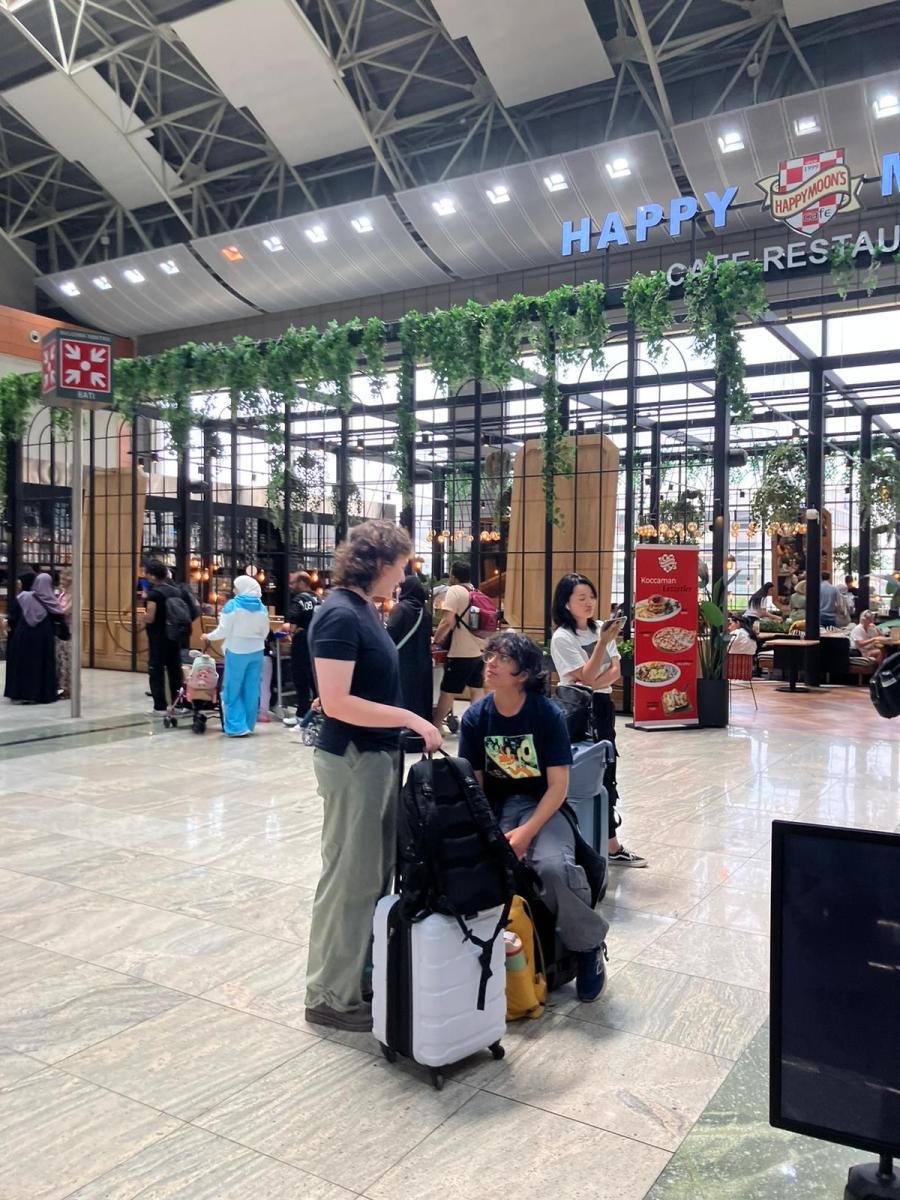
Yesterday, our class split in half, one heading to stay near the Istanbul Airport, the other preparing for departure from the Sabina Gökçen Airport.
Kacie and I woke up at 6 for an early flight to London Heathrow, where they split ways, Kacie heading to her home in Pennsylvania, while I stayed to tour London with my aunt.
In the Istanbul Airport, we encountered something interesting — a replica statue of Alexander the Great, advertising the Airport Museum. First opened in 2020, it displays different artifacts from museums all over the country. Encountering this advertisement (regrettably, we did not have time to stop in the museum itself) at the end of our class highlighted what we have been learning about over the course of this trip: how art and access to art can reflect how national identity is cultivated. Whereas before this summer I might have passed a sign like this by without much thought, I can now recognize it as an example of the effort on behalf of Turkey’s government to propone the country’s archeological sites and ancient art and artifacts not only to appeal to a tourist population, but to center itself as a place of importance in Europe’s historical narrative as part of an effort to make the country of equal standing to other EU nations.
Replica Statue of Alexander the Great in Istanbul Airport
The rest of our group, Dr. Pitamber, Wen Ting, Ana, Syd, and Paulina had a leisurely morning at the Villa Siesta Hotel. Dr. Pitamber, Wen Ting, and Syd headed back to enjoy Istanbul proper today, where our Professor and TA met back up with Dr. Human (and her daughter Rosemary and niece Ellie), and Syd showed her mom, Michele, around the city. Eventually, Dr. Pitamber and Dr. Human will continue their travels to Rome, Italy; Wen Ting to Singapore; and Syd to Greece! Paulina and Ana both headed back to their homes in Massachusetts together on an evening flight to Boston.
Photo of Dr. Pitamber, Paulina, Syd, and Ana at the Villa Siesta, Istanbul
The Sabina Gökçen Airport Group
The remainder of the class, Gabby, Sophie, Grace, and Carson, stayed at the Mihman Hotel before leaving on a flight together for Boston in the early afternoon. Massachusetts is the final destination for all except Gabby, who will stay with Sophie before heading home to Texas.
Grace and Gabby at the Sabiha Gökçen International Airport
Exploring London
My aunt and I arrived in London in the early afternoon and spent a relaxed day walking and exploring the shops near Paddington Train Station (where we encountered an amazing sculpture installation!) before ending our day at Liberty London, the historic department store.
The Liberty brand was originally founded in 1875, and after becoming a popular fashion company, opened up the building it remains in today on Great Marlborough and Carnaby Street. Built between 1922-24, the building is in the Tudor style, and was crafted using wood from the ships HMS Hindustan and HMS Impregnable (a modern implementation of the spolia we have seen in the ancient world), also reflecting the impact Liberty’s textile designs would have on the Arts and Crafts movement of the late 19th and early 20th century.
"Wild Table of Love," by Gillie and Marc (c. 2023), outside of Paddington Station, London
To celebrate its 150th anniversary, the top floor of the building hosted an exhibition of historic fabric prints and tiles. The tile exhibit was especially fascinating. Most featured were designed by William De Morgan, and feature Persian and Arabesque motifs. One large tile made for the cruiseliner SS Arabia features the cypress tree, a motif our class encountered in the context of Umayyad palace decoration, where the tree symbolized connection to the paradise of the afterlife (specifically in the context of garden decoration; the tree in other contexts could also symbolize hope, eternity, and immortality).
I was amazed to discover these tiles were exhibited next to one “Iznik Tile” (the bottom rightmost tile). Whereas all the other tiles were labeled by artist or company, and date of production, this general identification was the only information given about the lone work. Having visited a still operating ceramic workshop in Iznik just two days previously, I was now seeing its historic predecessor, but anonymous, and undated.
This exhibit was fascinating to me because it continued the historical narrative of this class into the modern period. The tiles exhibited, as well as some of the fabric patterns, display the emergence and rise of Orientalism in the Western art world. In the world of fabric and decoration, patterns such as the ones mentioned above (sometimes used also to decorate places of worship, such as mosques) were appropriated from Eastern art and became immensely popular “exotic” styles. Liberty as a company participated and contributed to this trend in its first years as a growing brand. Eventually, Liberty’s work become popular enough to be labeled a fashion movement: for example, the Art Nouveau style is referred to as ‘Stile Liberty’ in Italy.
Hallway of "150 Years Dedicated to Arts, Culture, and Design," Draped in Fabrics
End of the Day (and Trip) Reflections
Although I stumbled upon Liberty’s “150 Years Dedicated to Arts, Culture, and Design” exhibit by pure chance — I had no idea it existed when walking into the building — it felt like the perfect way to end this trip, an opportunity to reflect on how the ancient art and history I’ve been studying in Spain and Turkey connects to and is reflected in the modern day. Though I was sad to leave my classmates and Professor, encountering this exhibit proved to me the knowledge and experience I gained in this class will carry with me; what I have learned about exists not just in the past, or in the countries I have left, but leaves its traces globally and presently, speaking to the importance of studying Mediterranean art and history.
Lingering Questions
Having encountered Orientalism in this way, I would like to study it more thoroughly — how do Iznik tiles, specifically, become appropriated by Western manufacturers? Does mass production play a role in the popularity of this design? What other examples of Eastern art and culture — which we encountered in Umayyad, Abbasid, and Ottoman forms — became “exoticized” in this manner, and how did this Orientalizing mobilize itself between different European countries and America?
I hope all who have followed along with our journey have enjoyed reading our blogs as much as we have enjoyed writing them. Here’s to Leir Summer 2025: Medieval Mediterranean Cities!