


Seville and Granada are some of key flamenco centres in Andalusia. Having watched my first live flamenco performance in Madrid 6 years ago, I thought it was a good opportunity to take a flamenco dance class and dive more deeply into the intricacies of the art form since we are in Southern Spain. While flamenco includes singing (cante), dance (baile), and guitar playing (toque), I’ll be focusing more on the dance aspects of the art form for this blog post.
In Seville, I took two dance classes – one I found through google at a studio and the other through Airbnb experiences, with the highly skilled Romina. I wanted to compare these experiences as their audience seem slightly different just from their descriptions and images chosen. Flamenco is traditionally transmitted through oral tradition and observation, so I wondered how flamenco might be taught differently in present day contexts.
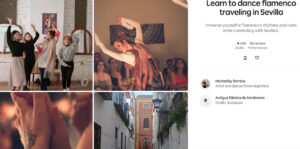
Airbnb experience page, screenshot from Airbnb
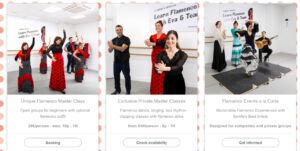
Flamenco dance class offerings from the studio website
Flamenco dance covers a wide umbrella of styles or “palos,” each with unique rhythms, tempos, and emotional expressions. These different styles might correspond to the occasion for dance – flamenco for weddings, religious ceremonies, festivals, socialising – all differ slightly in their form and rhythm. The easiest palos to learn is called tangos due to its 4-4 beat structure. In both classes, the tangos was taught.
Both classes started out with basic rhythms before going into groups of movement (coordinating feet and arms) and a short choreography towards the end. The studio class incorporated bits of history (e.g. some movements of the flamenco skirt were inspired by how women swished aprons in their everyday lives. Flamenco was not made for the stage, but an everyday form of expression). It was also highly focused on expression (evident in the way the call of ole! was part of the choreography towards the end).
The class by Romina was much more focused on the technical aspects of flamenco dance, and we drilled some of the flamenco footwork. There was even some arm exercises! From the videos, you might be able to hear that there was more multi-limb experimentation with the 4-4 rhythm in comparison to the studio class. Romina guided us through how the tangos can be used to convey different expressions through varying the speed of the 4-4 rhythm. She also explained that ole! was how flamenco performers connected with each other on stage too. Flamenco dancers may communicate with the musicians and singers if they want a change in pace through their movement, or give affirmation to their fellow performers with ole!. Saying ole! is a form of jaleo – energy and encouragement that is transmitted throughout the flamenco group and key in flamenco. It was also amazing to try out (and fail) at the 12 beat bulerias – a more complex palos that aims to express fiery emotions through its advanced footwork.
Both classes ended with a little dancing in a circle to reflect the social nature of flamenco and acknowledge its roots as everyday performance that is not only for the stage, but as social practice to connect with others.
reflections and lingering questions
Flamenco is part of the UNESCO list of Intangible Cultural Heritage. Given its ground-up roots (as a form of expression for the Romani gypsies under Spanish oppression) and complicated histories of multiple cultural influences, its portrayals as one of the key tourist sights for Andalusia and varied forms of transmissions now presents opportunities for us to learn how intangible cultural heritage might (or might not) be preserved. It strikes me that intangible cultural heritage is not just important in its final forms (the flamenco performance), but also in these processes of transmission. I wonder (1) if there are governing bodies for the teaching of flamenco, (2) how decisions are made on what palos might be worth more resources preserving, and (3) how policies ensuring the continuity of flamenco as a highly heterogenous art form are made. As an aside, both of the instructors are not from Spain – the instructor in the studio is a young flamenco student from Chile and Romina is an Argentinian. I wonder what the demographics of flamenco practitioners are and how their understanding of the art form might differ from Spanish national rhetoric of flamenco.
I preferred my class with Romina due to its attention to technicality. Showmanship comes after technique, and sitting with the difficulty of the learning process is part of learning flamenco. On the other hand, the class in the studio seemed very much geared towards a crowd that buys into a particular version of flamenco – the iconic red and black combination, ruffled dresses, and a red flower by the ear. Nonetheless, both experiences were extremely enjoyable and I’m looking forward to possibly attending another flamenco class in Granada! Will update this post if I do!