


Blogger, Jemma Salisbury
Today’s itinerary featured:
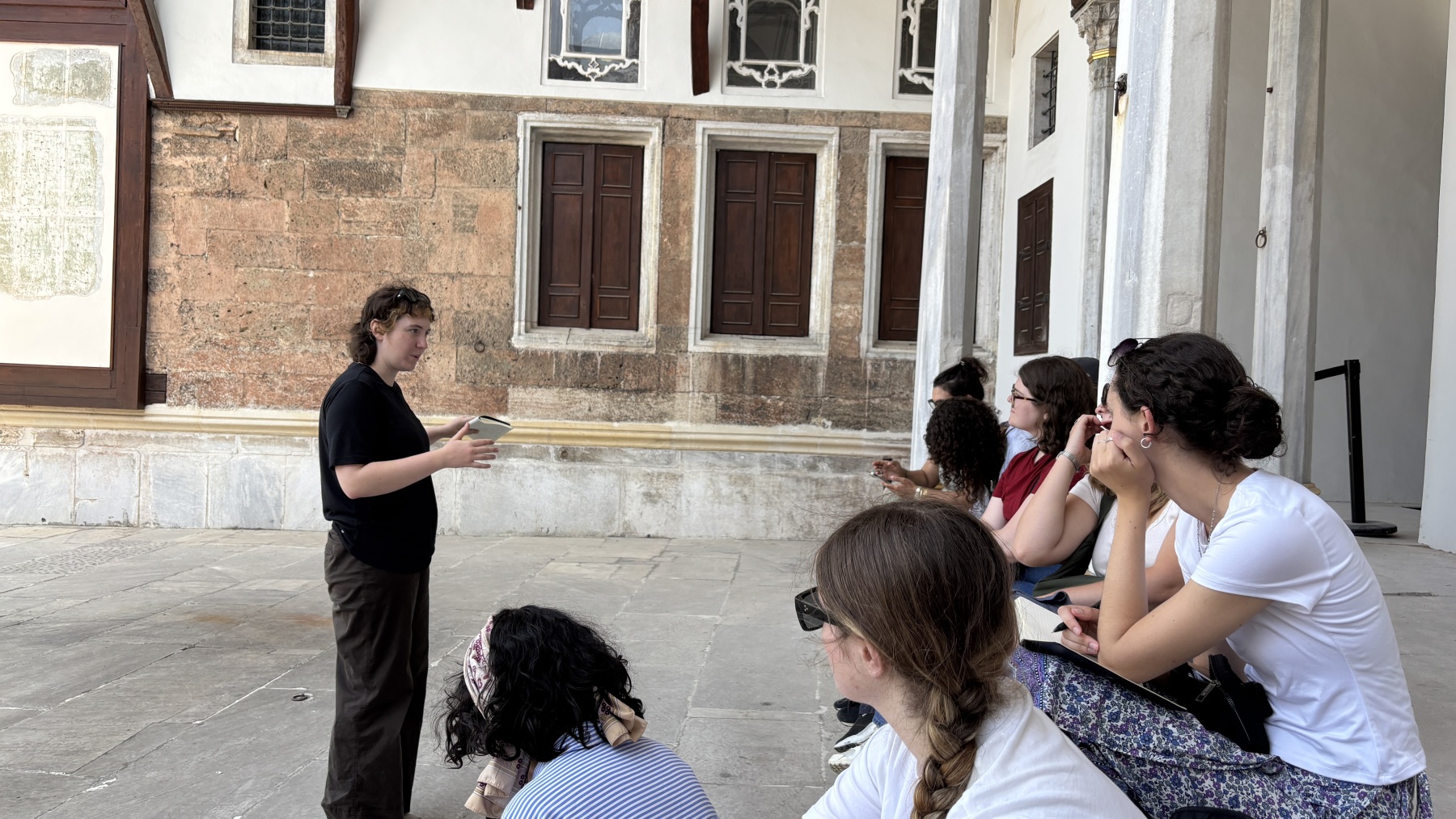
- A visit to the Topkapı Palace, with a presentation on its history by Syd Lyons and on its Harem by Grace Bramer
- Looking out over the Sea Walls of Constantinople, with a presentation by Sophie Mobray
- A visit to the Hagia Eirene, with a presentation by Carson Dobos
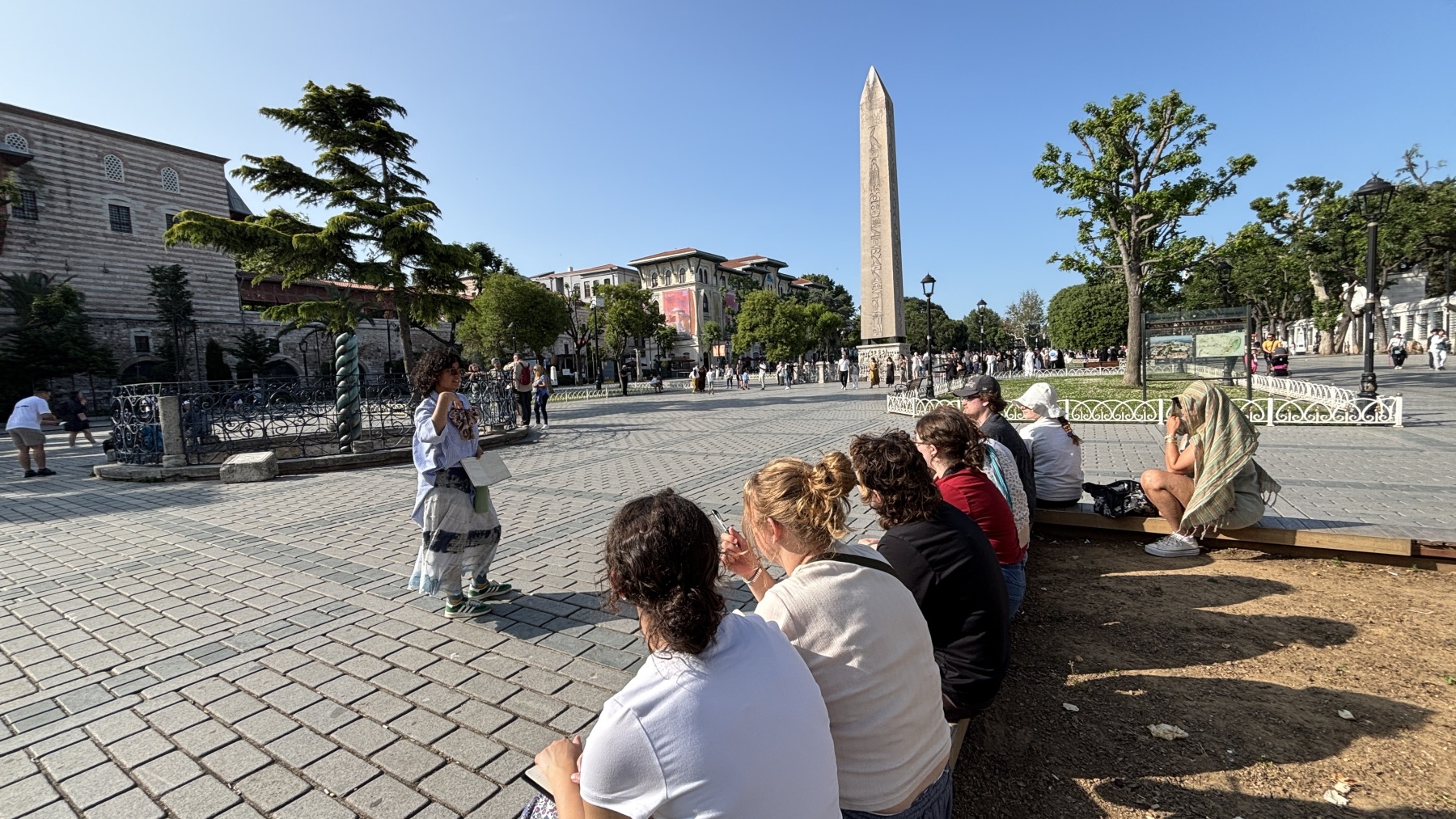
- Walking along the Hippodrome, with a presentation by Gabby de Leon
The Topkapı Palace
The Main Complex
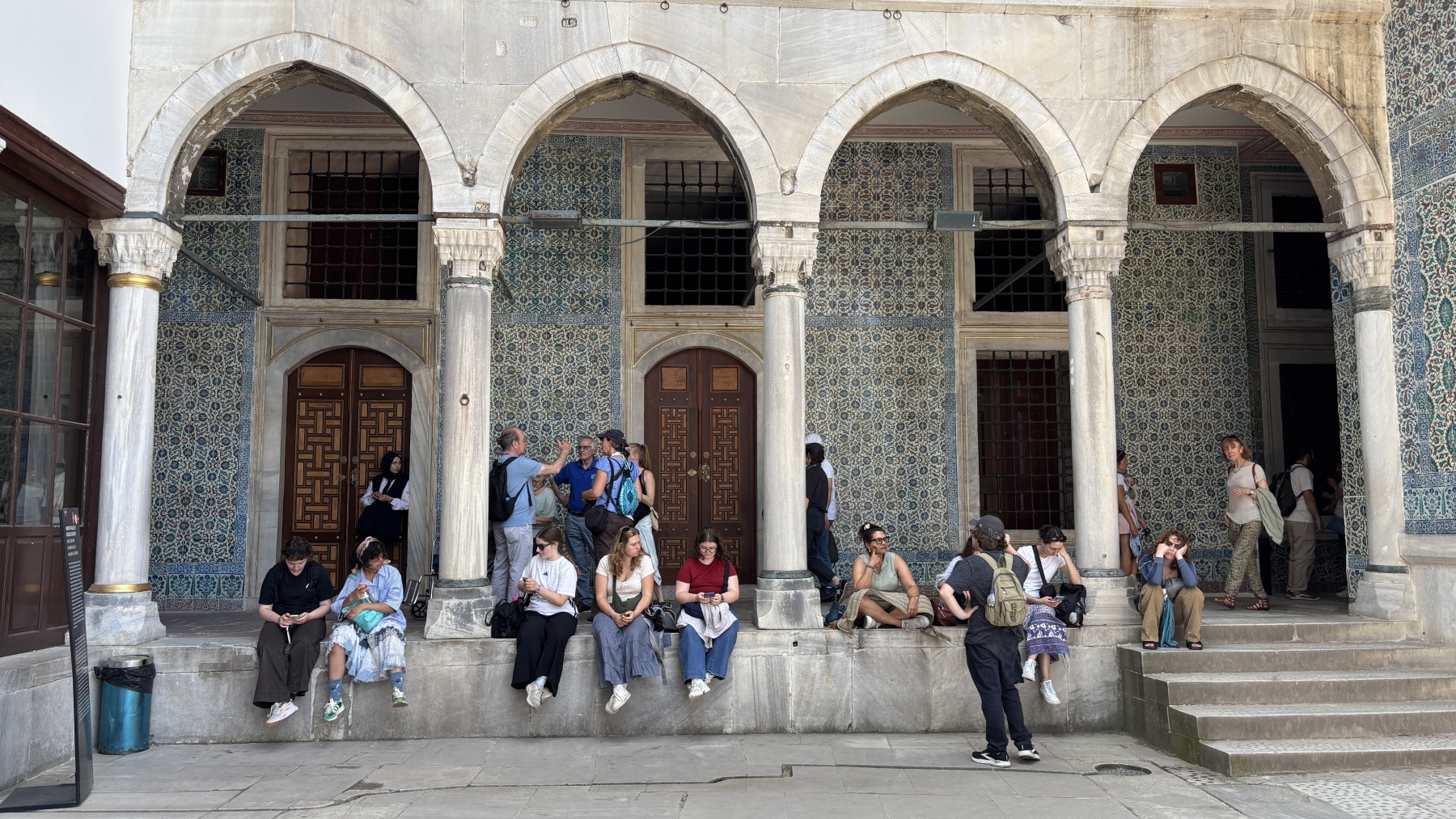
We entered the Topkapı Palace (or “Tan Gate” Palace, referencing its main entrance) ahead of a line winding around the block to gain entrance to the historic complex. Its first Ottoman building phase was initiated in the 1450’s by Mehmet the Conquerer. The complex’s buildings are organized around four central courtyards, each with their own grandly decorated entrance gates. Renovated continually by successive sultans, most of the current architecture left is from the 16th century, but aesthetics throughout the palace include Ottoman, Byzantine, Neo-Classical, and even Rococo influences. This wide range reveals the Ottoman empire’s international relationships, but also its desire to convey its power and influence through the same visual language of Western empires. Another important element of the Palace’s architecture is that, from the main entrance to the last courtyard, the entrances, courtyards themselves, and buildings become less accessible, and more private spaces, as public courts make way for the Sultan’s private residences.
The Harem
Deep inside the complex, another world is revealed. A harem, meaning “forbidden or sacred place,” (derived from the Arabic word haram) functioned as its own independent community within the royal court. The sultan’s wives, concubines, offspring, and other domestic workers lived together, their quarters organized around a marble courtyard at the far edge of the palace. Community spaces included a functional school and hamam, or bath. Many things about this space reveal the wealth and power of the Ottomans. Firstly, some concubines would be kidnapped or enslaved, given a salary but also forbidden from leaving the harem unaccompanied. Similarly, they were guarded by eunuchs who were also taken from other kingdoms, as the practice is forbidden in Islam. The harem was designed to contain hundreds of women, children, and workers, with more lavish living quarters given to the Sultan’s favorites — an ultimately very expensive endeavor. Thus, while one can marvel at the tilework, carved wood, and other beautiful detail throughout the harem as examples of Ottoman art, one must also consider the missing histories, or present absence, of countless women’s lives, unnamed and unrecorded in the empire’s history.
The Sea Walls of Constantinople
Our class had a beautiful view of the Sea Walls from Topkapı Palace, which separate Istanbul’s mainland from the Marmara Sea. Impressively, the walls consist of a single, continuous line of fortification, and have existed for centuries. While their date of construction is debated, the walls are mentioned in literature as far back as the 5th century. Their importance, which led to continual repair and expansion of the walls through the centuries, came from the need for the Byzantine Empire (and later, the Ottomans) to defend itself against naval attacks. Interestingly, though, the city has a natural defense system for this, as ships trying to reach land are blocked by the rough currents of the water. This may be why the walls are built unusually thin for their prescribed purpose. Spaced out along the sea wall are decorated gates, often inscribed with the name of the emperor or leader that commissioned them. These gates were also decorated and used for specific purposes – for example, the eastern gates were used for “triumphal entries” – revealing that this wall not only functioned defensively, but to further communicate the imperial identity of the city, acting as a living historical record as much as a defensive structure.
Sophie presenting on the sea walls of Constantinopole from Topkapı Sarayı
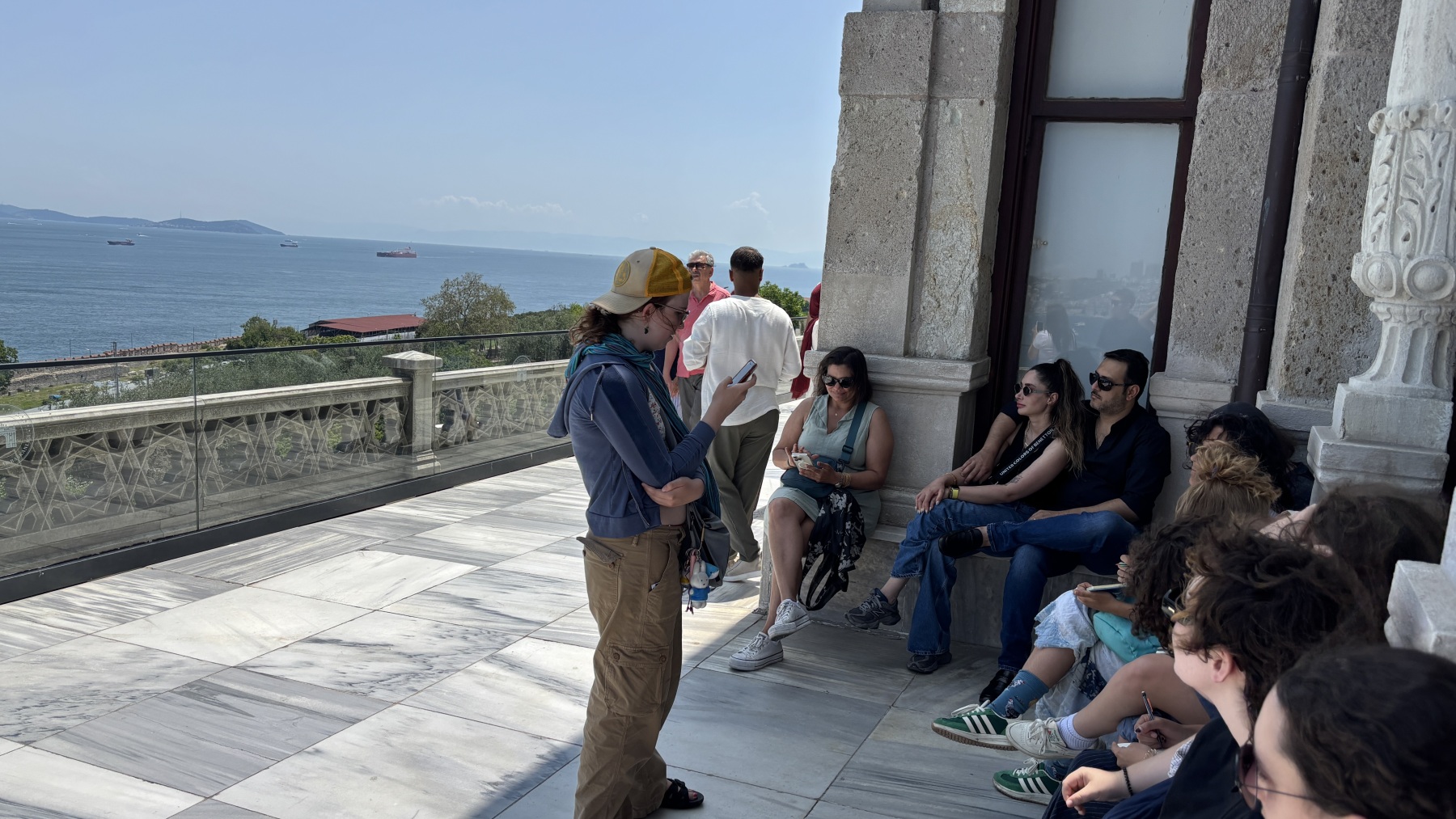
Photo by Wen Ting Ooi
The Hagia Eirene
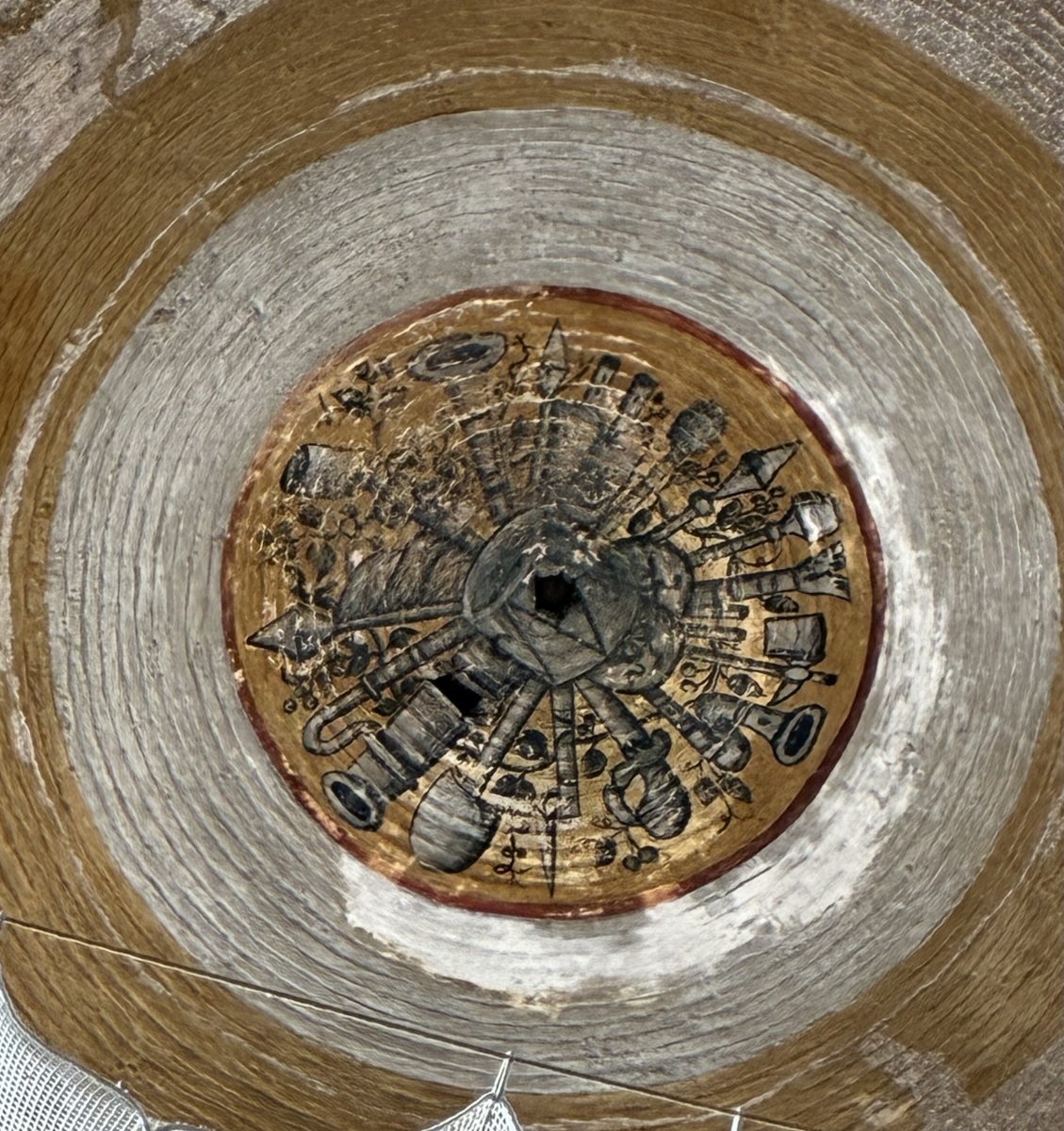
In the courtyard outside of the Topkapı Palace sits the Hagia Eirene (which visitors can gain free access to with their palace ticket!). Meaning “Holy Peace,” the church, originally Eastern Orthodox, is the oldest of its kind to still stand in all of Turkey. It is also one of the only Byzantine churches that was never converted into a mosque, making it a unique landmark. Originally built around 532 C.E., it was converted into a weapons armory by the Ottomans after the capture of Constantinople in the mid to late 15th century. This is evidenced by a strange painting in the main dome, which depicts various weapons and instruments. The only other painting is in the apse on the east side of the church of a large black cross against a yellow background. Unassuming upon first glance, this work is invaluable to our understanding of medieval history, as it is the only imagery in any church that remains from the iconoclastic period of the 8th and 9th centuries. In the 20th century, the church was designated as an archeological site, but also became a center for culture, as concerts and other big events were held in the historic building. Today, however, it is silent, covered in old scaffolding and detritus, isolated from everyday life in Istanbul.
The Hippodrome
Our last stop of the day was the famed Hippodrome of Constantinople. Though only traces of the original plan exist, the Hippodrome used to be a massive horse-race track – the original ground of which is currently two meters below surface level. Built circa 203 C.E. by Roman Emperor Septimus Severus, the track was an estimated 1, 470 feet long, and wide enough for eight four-horse chariots to race at one time. The middle of the track, or the spina, was lined with monuments taken after various victories, only three of which survive today. The Obelisk of Theodosius I ( r. 379–395 C.E.), is an Egyptian monument from the 1400s BCE, its pedestal of carved relief added after its relocation to Constantinople. The Walled Obelisk of Constantine VII (r. 913-959) originally got its name from the bronze plating that covered the column, which was sacked in the 4th Crusade. Between the two is the Serpent Tripod, a bronze statue made for the Temple of Apollo at Delphi in the 5th century BCE and brought to the city by Constantine the Great (r. 306-337). These columns are a testament to the continuity of the Byzantine empire’s imperial identity: each emperor built on the precedent of important leaders before him to create a visual connection between their reigns and legacy.
End of the Day Reflections
Today’s explorations shed important light on Istanbul’s imperial history. Each complex or architectural site visited had layers of creation which spanned centuries, demonstrating how important it was for the Byzantine empire to continue to add to its physical history, rather than building over or erasing traces of its past, as a way to demonstrate power through the longevity of an empire. The Ottomans continued to build upon these sites not to continue Byzantine legacy, but to subordinate it, to position the Byzantine Empire as the past, and the Ottoman empire as the regal future.
Further Inquiries
Some questions I have after today are: How did an Orientalist view of the Ottoman Empire impact its projected identity as a state and center of cultural and artistic production? Why are excavations or restorations seemingly paused in the Hagia Eirene, and what does it mean for the current state of Turkey to leave such a historic church in disrepair?
I am excited to continue examining the connection between visual history and imperial identity in days to come, especially in relation to religious sites. See you at the Kariye Camii!