


Blogger, Carson Dobos
Day’s highlights:
- Hagia Sophia (Paulina’s presentation)
- Column of Constantine (Jemma’s presentation)
- Kapaliçarşi Grand Bazaar
- Vlora Hanı
- Cats everywhere!
Hagia Sophia:
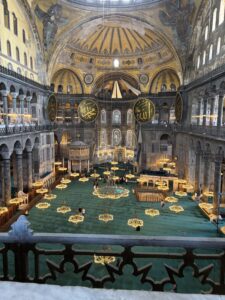
Viewed of Hagia Sophia with covered iconography. Photo by Carson Dobos
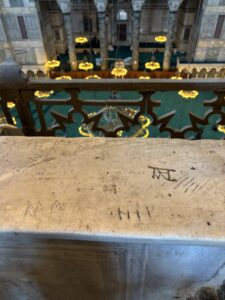
Viking Graffiti at Hagia Sophia. Photo by Carson Dobos
We began our first day in Turkey at one of the most famous sites, not only in Turkey but in the whole world! The Hagia Sophia, meaning Holy Wisdom, was originally dedicated as a church in 360 AD and finished in 527 AD. In Paulina’s presentation we learned and discussed the history of uses for the structure. In 1453, when the Byzantine Empire fell to the Ottomans, the church became a mosque and remained that way until 1935, when it became a secular museum. Controversially, in 2020 the museum changed back into a mosque, and much of the Christian iconography got covered. One of the features that amazed me most was seeing the graffiti from a Viking guard on one of the marble railings on the top level. The structure is noteworthy for the amount of changes it has gone through over the years, especially in terms of the different artistic and architectural styles of mosques and churches. Islamic art is notable aniconic so it does depict the human figure, whereas Orthodox Christian art uses many icons to depict the life of saints.
Column of Constantine:
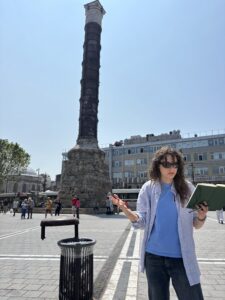
Jemma Salisbury presenting at the Column of Constantine. Photo by Carson Dobos
For our second stop, we went to Constantine’s column. The column commemorated the dedication of Constantinople by Constantine the Great in 330 AD. The monument is the oldest Constantinian monument to survive in Istanbul. In Jemma’s presentation, they talked about the use of the material porphyry for the creation of the column. The column was made of multiple purple porphyry blocks that were joined together. The column stood at the center of the Forum of Constantine and can be viewed as a symbol of national identity. How the cities construct their national identity is a topic we’ve been exploring throughout the course. In this case the grand scale of the column connects Istanbul to its rich history and connection to the Roman Empire.
Kapaliçarşi Grand Bazaar:
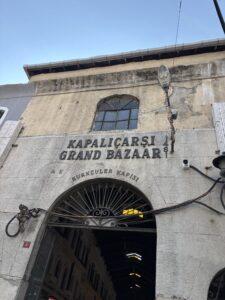
Kapaliçarşi Grand Bazaar. Photo by Carson Dobos
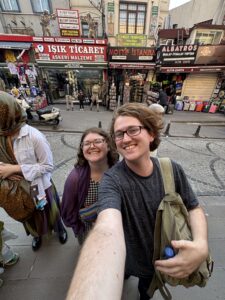
Carson Dobos and Kacie Lennon at the scarf shop. Photo by Carson Dobos
After our lunch break, I decided to go to the Grand Bazaar with Wen Ting, Jemma, Paulina, Kacie, Gabby, and Sophie. The bazaar was exciting and overwhelming—I’ve never seen so many people in one place. Many shop owners would smoke outside of their shops and shout sales pitches at the passersby. None of the prices are posted, so it is essential to haggle in order to get the best price you can. Nobody bought anything inside the bazaar but we found a nice scarf shop just outside the bazaar, and several people bought headscarves. We then made our way to the Egyptian Bazaar, Mısır Çarşısı. This bazaar is the second most famous one after the Grand Bazaar and is known for selling spices, sweets, and dried fruit. Nobody bought anything here either, but it was a wonderful experience to see and was less crowded and chaotic than the Grand Bazaar.
Vlora Hanı:
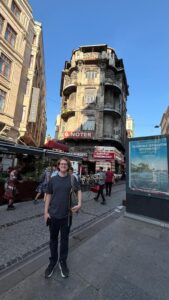
Carson Dobos at Vlora Hanı. Photo by Wen Ting Ooi
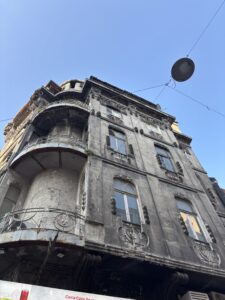
Vlora Hanı façade. Photo by Carson Dobos
After we finished at the Egyptian Bazaar, I convinced the group to stop at the Vlora Hanı, a decaying art nouveau building from the turn of the 20th century. Art Nouveau is an art movement inspired by the natural curves of plants and flowers, which I’ve observed in Spain and also in Turkey. The Vlora Hanı was built during a time when the popularity of Western decorative arts was spreading throughout Turkey. Art Nouveau even became popular with the Ottoman sultans, as can be observed by rooms such as the imperial orangery at the Yildiz Palace. In the Vlora Hanı, art nouveau can most easily be observed when looking at the windows and at the railings on the balcony. The façade even has stone flowers above the balcony and on either side of the windows for ornamentation. Unfortunately, the building fell into disrepair when the architectural style of art nouveau fell out of vogue.
Cats everywhere!:
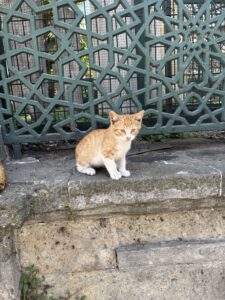
Small kitten. Photo by Carson Dobos
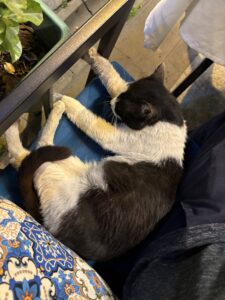
Sleepy cat at dinner. Photo by Carson Dobos
Throughout our adventures exploring Istanbul during the day, we were greeted by the city’s smallest furry residents, cats. Most all of the cats are very friendly and appear well fed, as the residents of the city can be seen feeding and taking care of them. One of my favorite interactions was with a little kitten near our hotel who we saw walking along a wall. During the heat of the day, the kitten was able to seek refuge from the heat by going behind the fence with his mother laying in the shade. Later that night, I had another lovely interaction with an older cat. Wen Ting, knowing I love seeing the cats, invited me to sit with her for dinner at Green Hill Cafe. One older cat came along and laid down next to us—we couldn’t believe how loudly he was snoring.