


Blogger, Carson Dobos
Day’s highlights:
- Alcazar Genil (Carson presentation)
- Museo Cuevas del Sacromente
- El Banuelo (Kacie presentation)
- Lunch at Capital Burger
- Alhambra
- Group Dinner #2
Alcázar Genil:

Wooden cupola roof, muqarnas cornices, and stucco wall decoration. Image by Carson Dobos
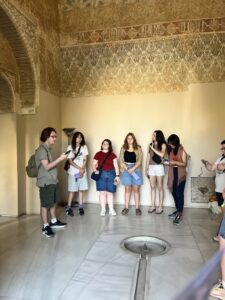
Carson Dobos presents on Alcázar Genil in Granada, Spain. Image by Sarah Lopolito
We began our day by walking to the Alcazar Genil, where I presented my research on the historic structure. The small palace was used as a private retreat and a farming estate. The palace was originally next to a pool, which provided an extensive water supply network for the agricultural industry in the area. The palace was decorated with stucco, which is a fine plaster that was molded and used to decorate the walls. Above the stucco is a cornice of muqarnas and a square wooden cupola roof, which is painted with geometric patterns. Muqarnas is a stalactite-appearing decorative element that softens the transition between the wall decoration and cupola roof. The courtyard of the palace was beautiful and still had many fruit trees, which are reminiscent of the agricultural past. Present day, the palace is maintained by the Francisco Ayala Foundation, which operates out of the 19th-century extension on either side of the palace. The foundation is dedicated to spreading the work of Francisco Ayala, who was an author from Granada buried nearby the palace. After enjoying ourselves exploring the grounds of the palace for 20 minutes, we caught a small bus to the Albaicin Quarter near our next stop.
Museo Cuevas del Sacromente:

Reading the plaques on the outside of the caves. Photo by Carson Dobos

Jemma and Paulina inside a cave dwelling. Photo by Carson Dobos
For our second site of the day, we trekked uphill through the San Pedro neighborhood of Granada to the Museo Cuevas del Sacromonte. After arriving, we stopped briefly and enjoyed cold drinks from the outdoor bar. The museum’s focus was on the history of cave dwellings and had many rooms to explore that were furnished with objects the residents would use. Granada was an important center of cave dwellings, and in the 19th and 20th centuries, many Romani traveler immigrants and other marginalized groups moved there because of their affordability and safety. The museum also chronicles the origins of flamenco, which originated in Spain around the time that many Romani immigrants arrived in the area. The museum hypothesizes how there are no similar dances from their countries of origin; however, most of the initial major flamenco singers had Romani names. One aspect of the museum that I really enjoyed was how they chronicled the existence of cave dwellings throughout the world. The museum mentioned dwellings in various countries across Europe and Asia, including France, Bulgaria, Libya, Jordan, and India. One common benefit of cave dwellings is their good use of bioclimatic conditions, leading to their ability to keep an even temperature inside.
El Banuelo:

Kacie Lennon presenting at El Banuelo. Photo by Carson Dobos
We returned today to El Banuelo, where Kacie gave a presentation on Islamic bathing culture. The bath, or hammam, was built in the 11th century and actively used up until the 16th century. It is located along the Darro River, which we walked along on our way there. After entering the main relaxation room, we went through the cold room (bayt al-bārid), warm room (bayt al-wasṭānī), and hot room (bayt al-sakhūn). An interesting feature of the bath, which Kacie mentioned in her presentation, is how the bath is warmed using hypocaust heating. The service room contained a furnace that generated hot air and pumped it through pipes under the floor to heat the other rooms. One of the most stunning aspects of El Banuelo was the skylights in the warm room, which let in small rays of light through octagonal and star-shaped holes. The hammam served as not only a place for hygiene but also socialization while progressing through the rooms.
Capital Burger:

Lunch at Capital Burger. Photo by Carson Dobos
During our lunch break, a majority of the group went off in search of Mexican food. We were unable to find Mexican food that was open, as it was siesta time and most restaurants were closed, so we decided to stop at the place across the street from our hotel, Capital Burger. I got a delicious chicken sandwich, and so did Grace and Kacie, and the rest of the group got a mix of hamburgers and veggie burgers. The prices were overall very reasonable, and it reminded me of home to have some delicious fried chicken and french fries.
Alhambra:

Generalife Palace garden. Photo by Carson Dobos

Wen Ting and Ana with a stream of water that flows down the handrail. Photo by Carson Dobos

Antonio showing us the details in the masonry. Photo by Carson Dobos

Star shaped dome in the Hall of Abencerrajes. Photo by Carson Dobos

Court of Lions: Fountain. Photo by Carson Dobos
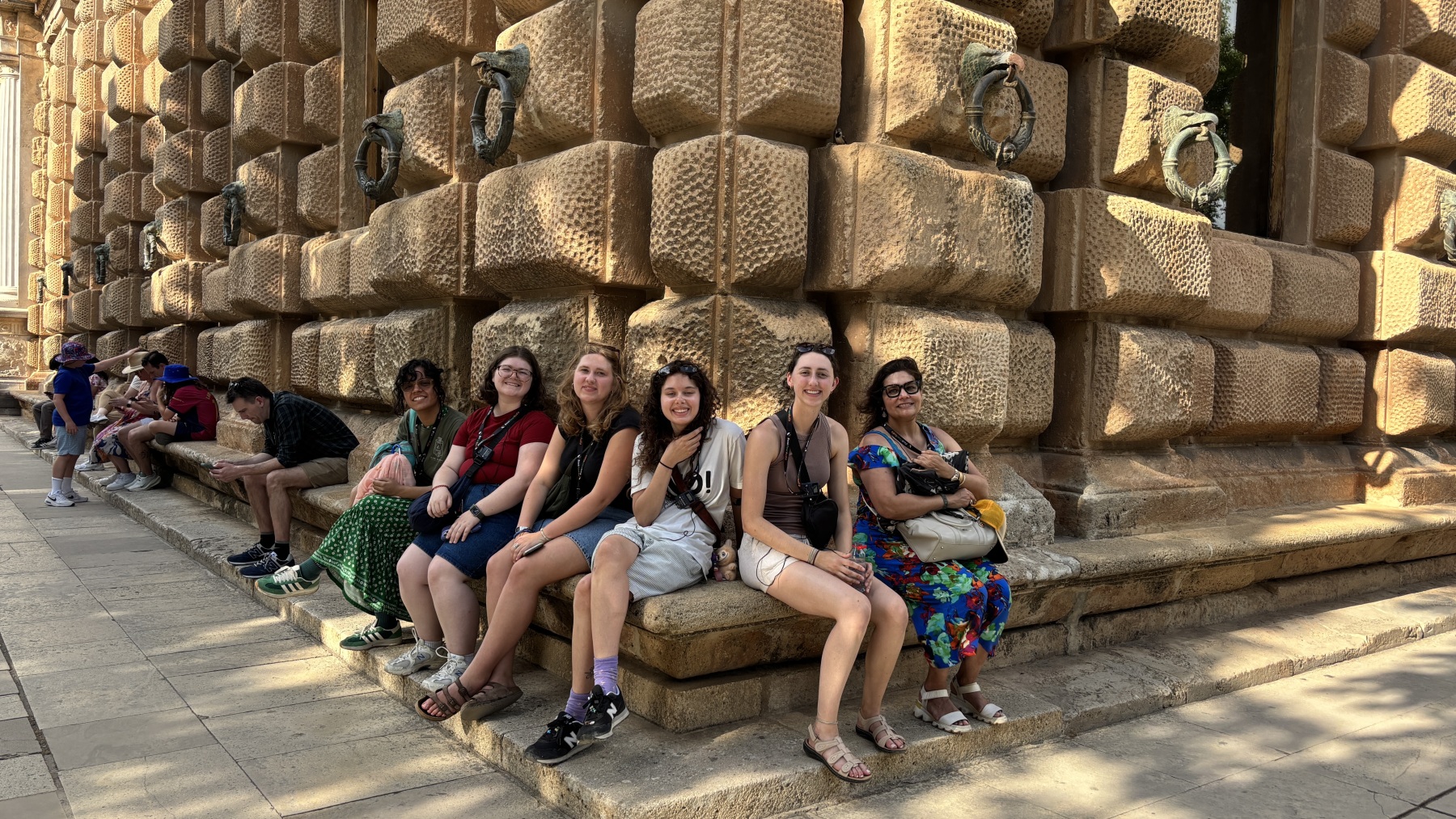
5-minute break in the middle of the Alhambra tour. Photo by Sarah Lopolito
At 5:00 we made our way to the Alhambra palace for our guided tour with our dynamic tour guide, Antonio. The Alhambra palace was first begun in 1238 by the Nasrids. The palace is in the Moorish style, characterized by its use of the courtyard as a central place and the carved stucco, tile mosaics, and geometric motifs. We first went toward Generalife, which was a summer palace that was directly uphill from the Alhambra. We walked through the gardens and admired the incredible water systems on our way to the main palace. We were even able to drink some of the water that was flowing at the top of the staircase. The palace was meant to be like heaven on earth, where water flows continuously from the top of the complex to the bottom. One of the most visually stunning elements of the Alhambra palace is the star-shaped dome at the Court of Abencerrajes. The muqarnas decoration around the dome makes it appear glowing and multi-dimensional. The Court of Lions was my favorite area of the Alhambra palace. I particularly loved the fountain in the center that was adorned by lions on all sides.
Group Dinner #2:

Lamb dinner entree. Photo by Carson Dobos
After finishing our tour at the Alhambra, we went for our second full group dinner at the restaurant at the Vincci Hotel. This time we were joined by Sarah Lopolito and her son, Aidan. The restaurant served us a three-course meal, and we ordered ahead of time, which avoided any confusion. We sat in a gorgeous indoor courtyard, and our table was enormous. Dr. Pitamber and Wen Ting ordered a delicious Spanish tomato soup called salmorejo that they shared with the table. For my main course I ordered lamb, which was really tender and flavorful. After dinner I still had room for more dessert, so I walked to a gelato place with Sydney and Kacie. I ordered mint tea gelato, and it was the best I’d had so far in Spain.