


Blogger, Sophie Mowbray
Monday morning was an early wake up call. After a calm rest day, we had a busy beach day ahead! With only 15 minutes between the start of breakfast and out scheduled leaving time, everyone was a little rushed. Unfortunately, this lead to Aiden Lopolito sleeping in and missing the train. We walked to the train station in the sunrise. My friend Gabby took advantage of Aiden’s absence and stole Sarah Lopolito’s window seat. Not cool Gabby!
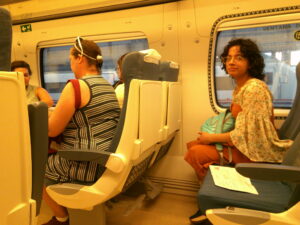
Gabby Stealing Sarah’s Spot- By Sophie Mowbray
On the train, Doctor Pitamber created a path for our presentations! Cadiz is on a tiny peninsula and we had four presenters that day (Ana, myself, Gabby, and Ari) so we covered almost the entire thing! On the first walk to La Bella Escondido, the building Ana was presenting on, Ana and I kept raving about how excited we were to go swimming. I marked the location of the building because it remained a little off the trail, as it is privately owned and we could not see it up close.
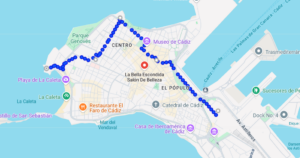
Doctor Pitamber’s Planned Walk + La Bella Escondida on Google Maps By Sophie Mowbray
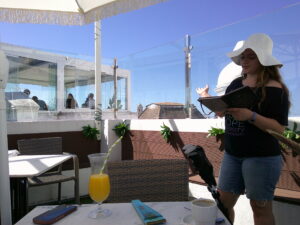
Ana’s Presentation- By Sophie Mowbray
To view La Bella Escondida (or in English, the hidden beauty), we had to travel up to the top floor of a hotel. Before we got up there, Doctor Pitamber generously treated us to coffee and smoothies from the restaurant. Ana told us about how the building was erected during Cadiz’s Golden Era, the colonial era of Spain. The tower was unique in comparison to others in the area as it was covered in ornamental Baroque design elements. It was grandeous in size, it’s vertical height, which was planned to the intention of the merchant who erected it. The tower was intentionally larger than other watch towers, which is a sign of Baroque architecture. Another sign of this Baroque influence is the ornate and over the top decorations that scale the vertical walls. I put a picture of it below, in which it is in the center. It is the most decorated of the three, highlighting the spectacle that the Baroque architecture gave it in comparison to neighboring structures.
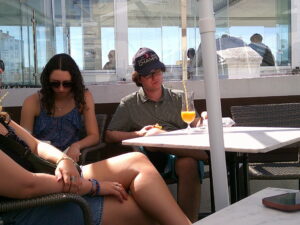
Taking Notes- By Sophie Mowbray
It was also octagonal in contrast to the other squared-shaped towers in the area. This allowed for a 360 degree view of the city. As Cadiz was a prominent naval and trade city, it was curious that La Bella Escondida remained the only one with this kind of view point. The funniest part, at least to me, was that this was a structure gifted to the owner’s daughter and has remained private property since. However, this makes the presence of a 360 degree view increasingly odd. As a city of such naval and economic relevance, it was a curious consideration as to why this approach was not considered in more buildings. I was considering my notes for my presentation throughout Ana’s. Though it was not more common place at the time however, it was very fitting as this tower was put up in the golden age of the city. It matched the environment that was being created in the city, as it was growing rapidly due to its seaside geography. I found it beneficial to have the advantage of my prior studying on the history of the subject, which the others would not hear about until later, to provide a better understanding of where this architectural choice stemmed from.
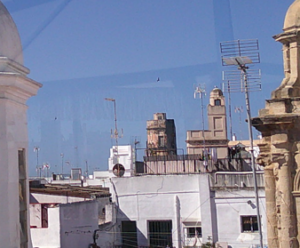
La Bella Escondida By Sophie Mowbray
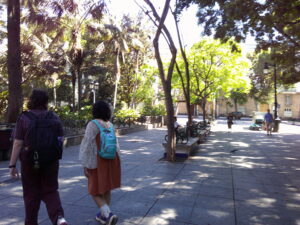
On the Walk- By Sophie Mowbray
Afterward, we walked through this lovely park for my presentation! I talked about the history of the port of Cadiz. It had been a trading post for centuries, and continues to be one to this day! I finally got to share with the class some of the reasons why the tower that Ana had presented on was so relevant to be built in Cadiz. Cadiz is a city that has faced consistent destruction. Pirate enemies and other European nations targeted it because it had been so importantly placed. It has actually been burned and leveled more than once! Throughout this consistent destruction though, Cadiz adapted to the attacks and took steps to fortify. They built up many fortresses and towers to obtain stronger defense, like Ari (spoiler alert!) and Ana had presented on that day. Their ability to overcome and rebuild into something stronger and continual vitality allowed them to grow into both an incredibly relevant city in both modern day and antiquity. The Romans, who once shipped fish and salt out of these ports would marvel at the high tech cranes that are being used to ship out modern day goods out of the Port of Cadiz.
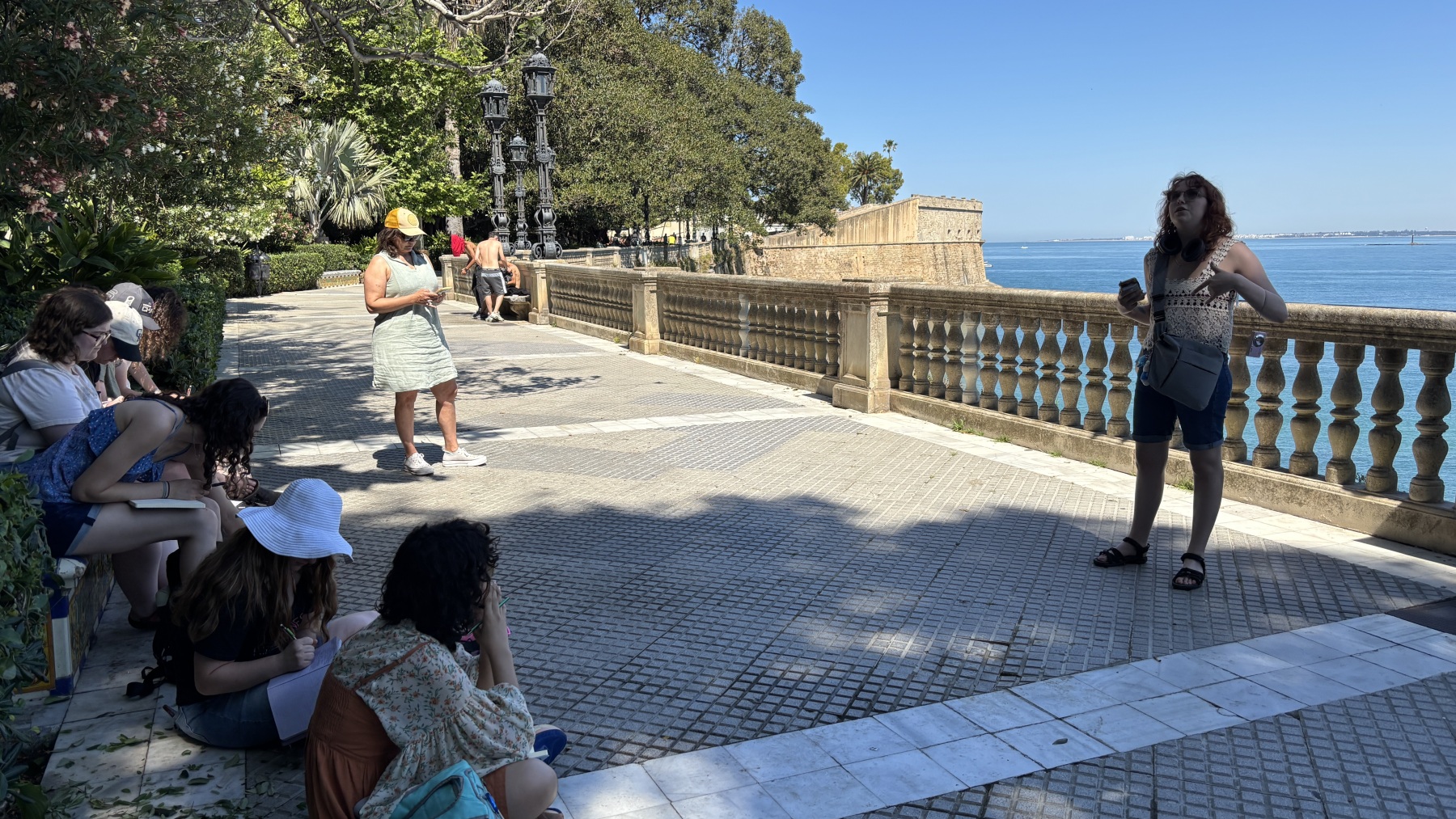
Port of Cadiz- By Sophie Mowbray
One of the best benefits of this trip is how the presentations allow us to reflect on how different places in that we are visiting are all connected. Not only just within cities but within the country as a whole. In this instance, Cadiz has a history of being a large financial center, but only because the House of trade moved there because travel into Sevilla was limited due to sand rising in the river. That very morning, we had taken a trip from Sevilla to Cadiz via train! Having seen both cities that were once financial centers allowed us to reflect on how they both thrived in different ways. It also allowed us to reflect, at least in this point of the day, more on how geography of a city effects its history, and how this history effects the architecture. Because Cadiz is such a vital port city, it was attacked, because it was attacked, the people fought back through architecture.
Sophie’s presentation on the Cadiz port and history By Wen Ting Ooi
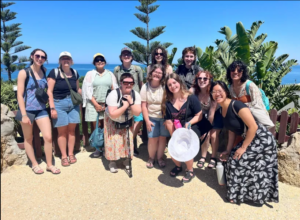
Group in Garden- By Sarah Lopolito
We stopped in a beautiful garden with lots of plants from across the empire. It was called the Jardines de Alameda Apodaca. The Gardens and and it’s many plants was used as a symbol of the expansive nature of the empire and access to a wider variety of resources. It was enlightening and provided insight into how the empire wanted to be perceived. By having a wide variety of different flora, the empire exhibited strength through the power of the unorthodox and exotic. I thought to compare this to exhibitions in other European empires at that time. I took a British Empire class last semester in which we discussed how places like the British Museum did similar things, by taking artifacts from the lands they conquered to display as tokens of success. Seeing this represented as plants was fascinating. As I was appreciating the beauty of it all, it served as a quiet, yet bold reminder of the goals of empire and how they live among us even into the modern day.
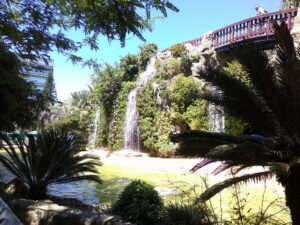
Empirical Gardens By Sophie Mowbray
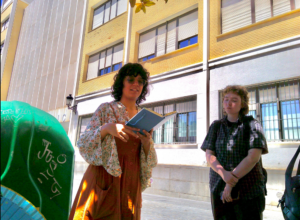
Gabby Presenting By Sophie Mowbray
Our next stop was for Gabby’s presentation, the Gran Teatro Falla. It is an old theatre that was destroyed in a fire in the 18th century. The rebuilding process started in 1884 and finished by 1905. The rebuilt building was made by Adolfo Morales de Los Rios, but finished by Juan Cabrara de la Torre. It was eventually restored from 1986-1991 Raphael Ortero and Jose Antonio Caravajal. It has been rebuilt in a somewhat unusual way. Inside, the seats are structured in a horseshoe shape. But the stage does not stick out enough to make it viable for those in side seats to see what the whole performance looks like. On the outside, however, the building shows clear Muslim influence in the architecture. This is a practice known as Neo-Mudejar, which is a type of architecture style in Spain where they practice the revival of old Moorish architecture. In this building it can be seen in the arches and some geometric designs on the walls. We couldn’t go in, which was a shame, but it had a stunning exterior.
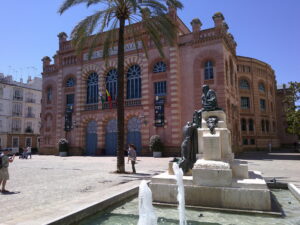
El Teatro- By Sophie Mowbray
It was finally time for Ari’s presentation which was at El Castillo de Santa Catalina. It was a fortress that was unorthodox as it was not fortifying people the way many fortifications are. It was built during an era of consistent bombardment from outside forces, serving as a new way to protect the city. However, this was not the only way this building served to protect. It also served as a prison for military enemies, one of whom was Napoleon! It harked back to our group discussions during both my and Ana’s presentations. This city is a beach city. Even if the sea was not a clear and constant reminder of such, the fortress and it’s military and prison purpose tell a story of an area of navel glory and defense. It was built as a response to the Anglo-Dutch attack of 1596. The city is a responsive model, that has grown from everything that has kept it destroyed. A metaphor I remind myself of throughout even the hardest travel days of this trip.
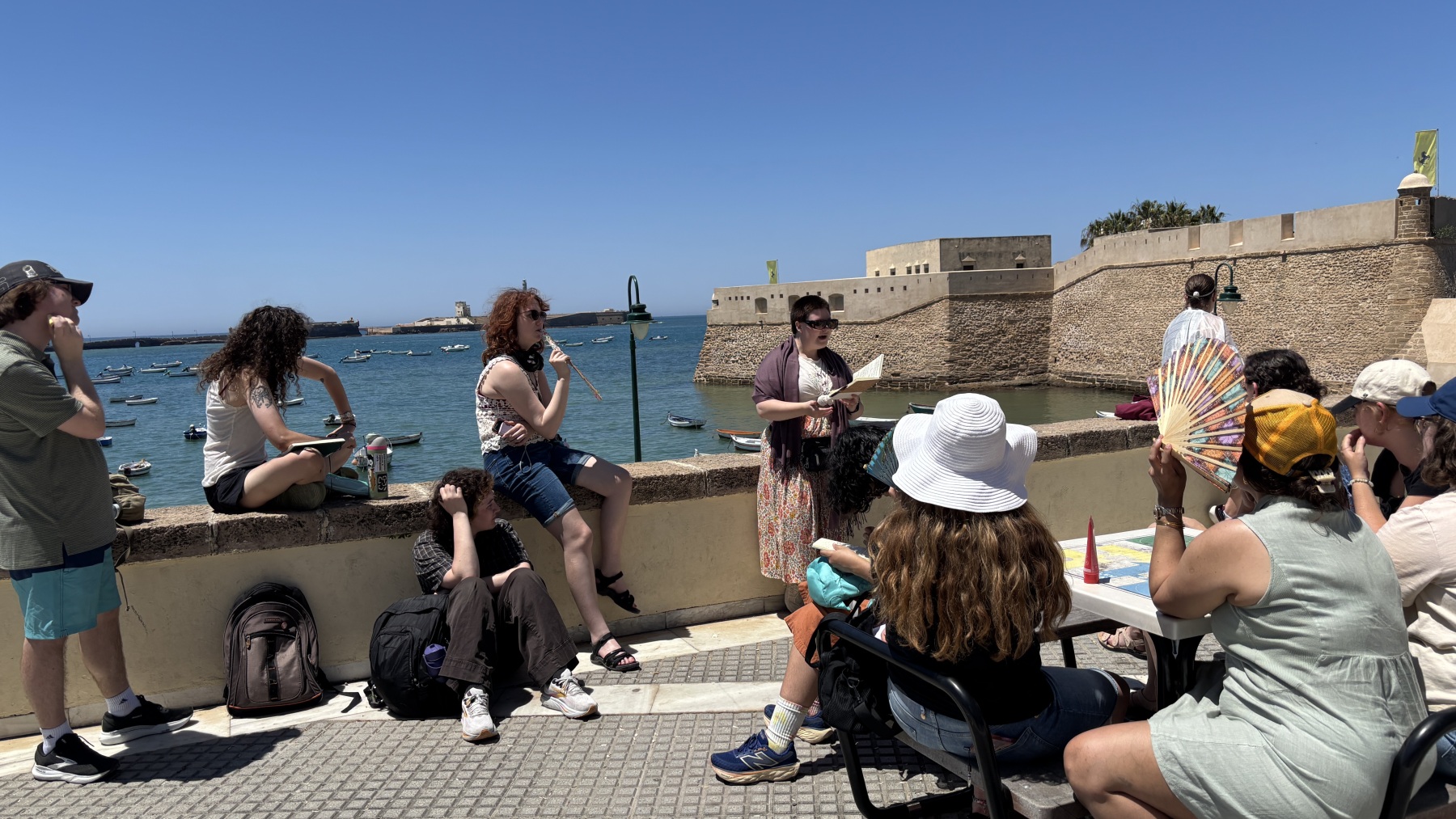
Ari’s presentation on Castillo de Santa Catalina By Wen Ting Ooi
After that, it was lunchtime! Gabby found this local sandwich shop that was overflowing with business. Unfortunately, it was a 30-minute wait. Gabby, Ana, Ari, and I pushed on to this other local spot that Gabby found. It was similar to a bodega in the USA. We ordered sandwiches all with local ingredients and they were amazing. We also tried a Xuixo, a type of local pastry, and it was so yummy! It was similar to a filled doughnut. Ari split off to go on a walk, so Gabby, Ana, and I sat down in a park to eat.
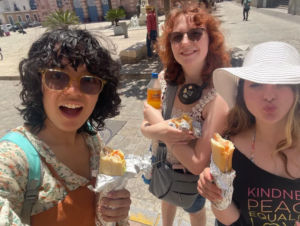
Sàndwich Selfie By Gabby de Leon
FINALLY, it was beach time! We took pictures and played games. Ana and I swam out as far as we thought safe, and others, like Grace and Gabby, climbed the rocks. Carson found some beautiful sea glass! We were there for six hours so we had time for snacks on the beach. My favourite was the chocolate strawberries courtesy of Grace. When the tide was low we also explored the tide pools. Carson, Paulina, and Ana got up close and personal with the animals which was very brave. There were lots of crabs that might pinch! Luckily we made it out unscathed.
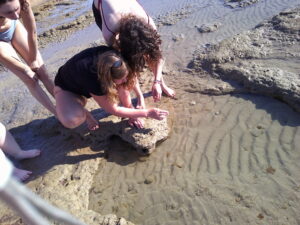
Tide Pools- By Sophie Mowbray
As the tide went out, the rocks washed out to reveal more of the fortresses that surrounded us. The beach was in between the Castillo de Santa Catalina fortress that Ari discussed, and another fortress called Castillo de San Sebastian. Both were built up and restored as a result of the Anglo-Dutch attack of the city in 1596, one of it’s many encounters with being sacked. It was a valuable moment for understanding the area, as the tide pulling out, allowing us to see more of the fortress, revealed to us the importance of defending the area from enemies and what that meant for the people of Cadiz. At one point, this was not just a beach. As a port city, it was sacked countless times because of it’s historical value to the Spanish empire, and all who came before it, for it’s economical structure. Being able to reflect on this was one of the many gifts of spending so much time on the sea side.
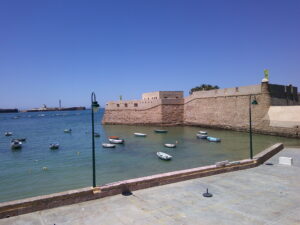
Castillo de Santa Catalina by Sophie Mowbray
The train ride back was sandy and long, especially because Grace and I discovered ourselves incredibly burned from the sun. That night I took it slow cause of the pain. Gabby and Grace came back to our room—lovingly dubbed the penthouse—with McDonald’s, and we enjoyed McFlurries with Filipinos, which were delicious! Winding down with a relaxed evening was a fitting end to a hectic day.